




Kirkuk ranks second nationwide in the number of women heading households, according to final results from Iraq’s most recent population census.
The census shows that in Kirkuk and four other provinces—Nineveh, Diyala, Salah al-Din, and Anbar—the female population is higher than the male population.
These provinces have all experienced significant conflict in recent years, especially during the war against the Islamic State of Iraq and Syria ISIS, which claimed thousands of lives. This loss has contributed to a demographic imbalance, placing Kirkuk second in Iraq in terms of higher female-to-male ratios.
Iraq’s total population, including the Iraqi Kurdistan Region IKR, has passed 46 million with 340,000 foreign nationals included. Roughly 30 percent of residents—about 14 million people—live in rural areas.
Males make up 50.2% of the population (23,161,000), while females represent 49.8% (22,957,000). Out of 8,054,385 total households, over 7 million are male-headed and more than 910,000 are headed by women.
The national average household size is 5.7, though this varies across provinces. Children aged 0–14 account for 35.9% of the population (over 16 million), while working-age adults (15–64) represent 60.4% (around 28 million). Those aged 65 and above make up 3.6% (more than 1.68 million). Iraq contains 8.34 million private housing units, excluding government and military properties. Nationwide, 72.14% of people own their homes or live with parents, and 19.41% rent.
Kirkuk: Women Slightly Outnumber Men
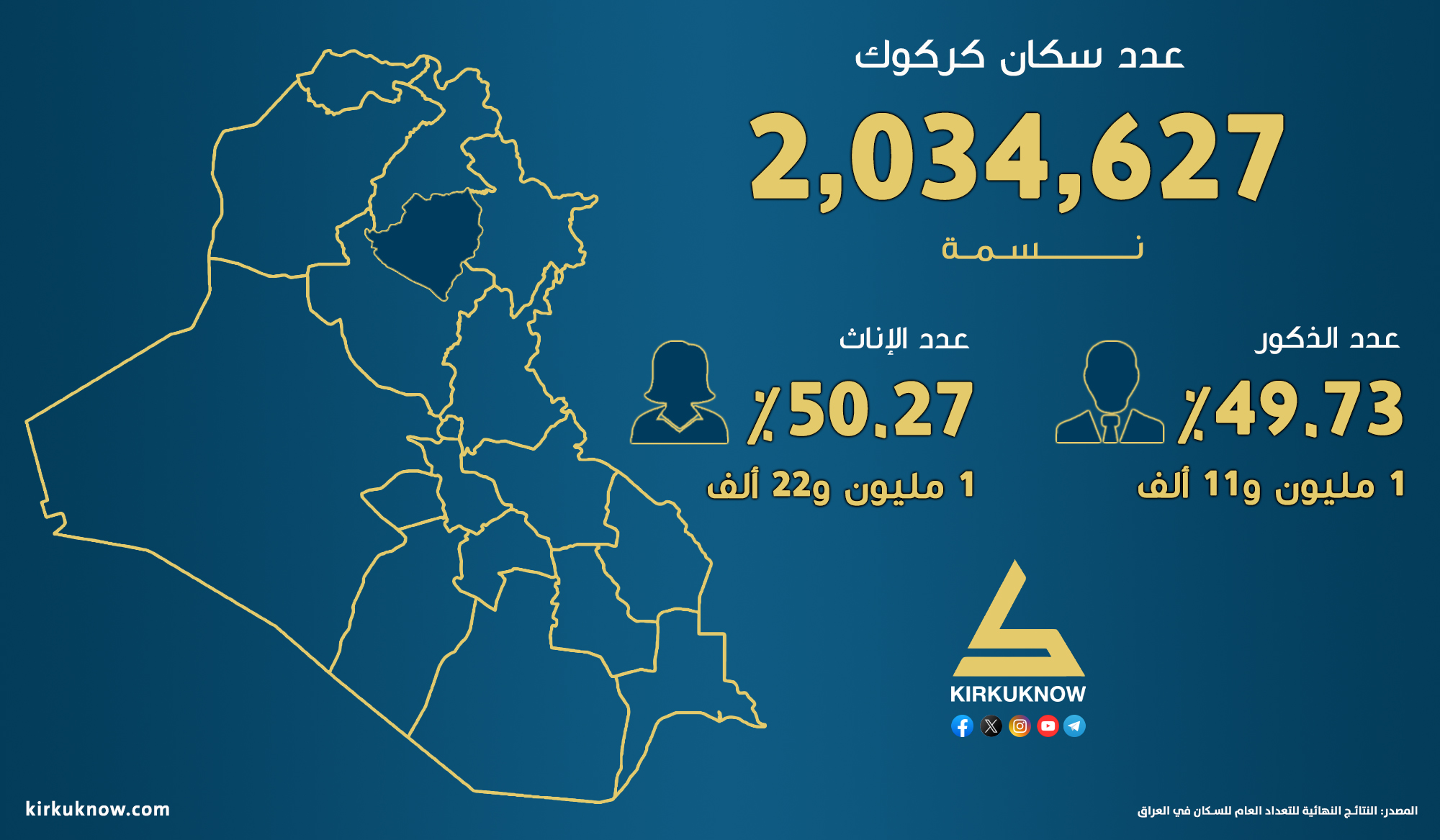
Kirkuk’s population has reached 2,034,627—about 4.4% of Iraq’s total—ranking it eighth in size. Of these residents, 26.5% live in rural areas.
Kirkuk is among the few governorates where women are the majority. Women make up 50.27% (1,022,866), while men account for 49.73% (1,011,761).
The governorate consists of four districts:
- Kirkuk Center: 76.15%
- Hawija: 15.79%
- Daquq: 4.22%
- Dibis (Dubiz): 3.84%
Average household size is 5.15. Male-headed households make up 86.35%, while 13.65% are headed by women—placing Kirkuk second after Baghdad.
Adults aged 15–64 form the largest age group at 60.72% (1,235,440), followed by children 0–14 at 35.38% (719,946). Seniors aged 65+ make up 3.89% (79,241).
Housing ownership is distributed as follows: 62.13% own or live with parents, 22.44% rent, 13.36% live in free housing, and 2.07% reside in government rentals.
Housing types include:
- 92.65% houses
- 5.60% apartments
- 1.47% mud-brick homes
Around 89% rely on domestic water supplies, and 45% are connected to public sewage networks. Waste collection covers 60% of the governorate, while 11% of waste is burned.
Nineveh: Iraq’s Second Most Populous Governorate
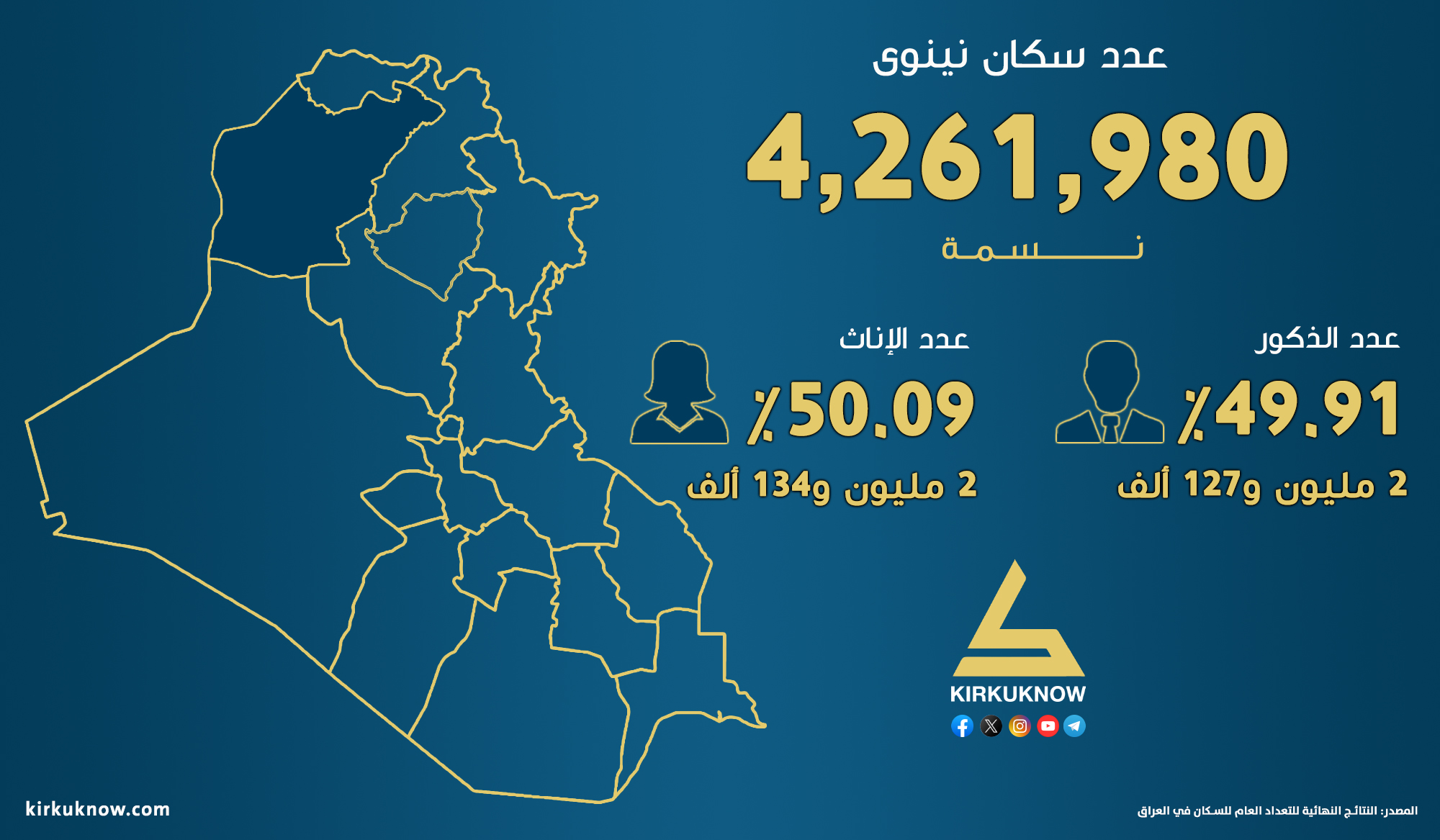
Nineveh has a population of 4,261,980 (9.2% of the national total), second only to Baghdad. Nearly half of its population (45.8%) lives in rural areas.
Women slightly outnumber men in Nineveh as well:
- Females: 50.09% (2,134,758)
- Males: 49.91% (2,127,222)
Nineveh includes nine districts, with Mosul accounting for 55.06% of the population. It is followed by Tal Afar (12.82%), Tel Keif (9.54%), Hamdaniya (5.86%), Makhmur (4.98%), Shingal (Sinjar) (4.72%), Al-Baaj (4.72%), Sheikhan (2.76%), and Al-Hadar (1.42%).
The average household contains 6.46 people. Men head 87.28% of households; women head 12.72%, ranking Nineveh fifth nationwide.
Most residents (57.57%) fall within the 15–64 age range. Children (0–14) make up 39.38%, while seniors (65+) account for 3.05%.
Home ownership is relatively high: 70.26% own or live with parents, 18.62% rent, 10.20% have free housing, and 0.92% live in government-provided housing.
Housing types include 89.17% houses, 5.93% apartments, and 2.57% mud homes.
About 85% depend on domestic water sources, while more than 23% of wastewater enters public sewage systems. Less than half of the province's waste is officially collected; 14% is burned and 36% is disposed of by other means.
Diyala: Majority Working-Age Population
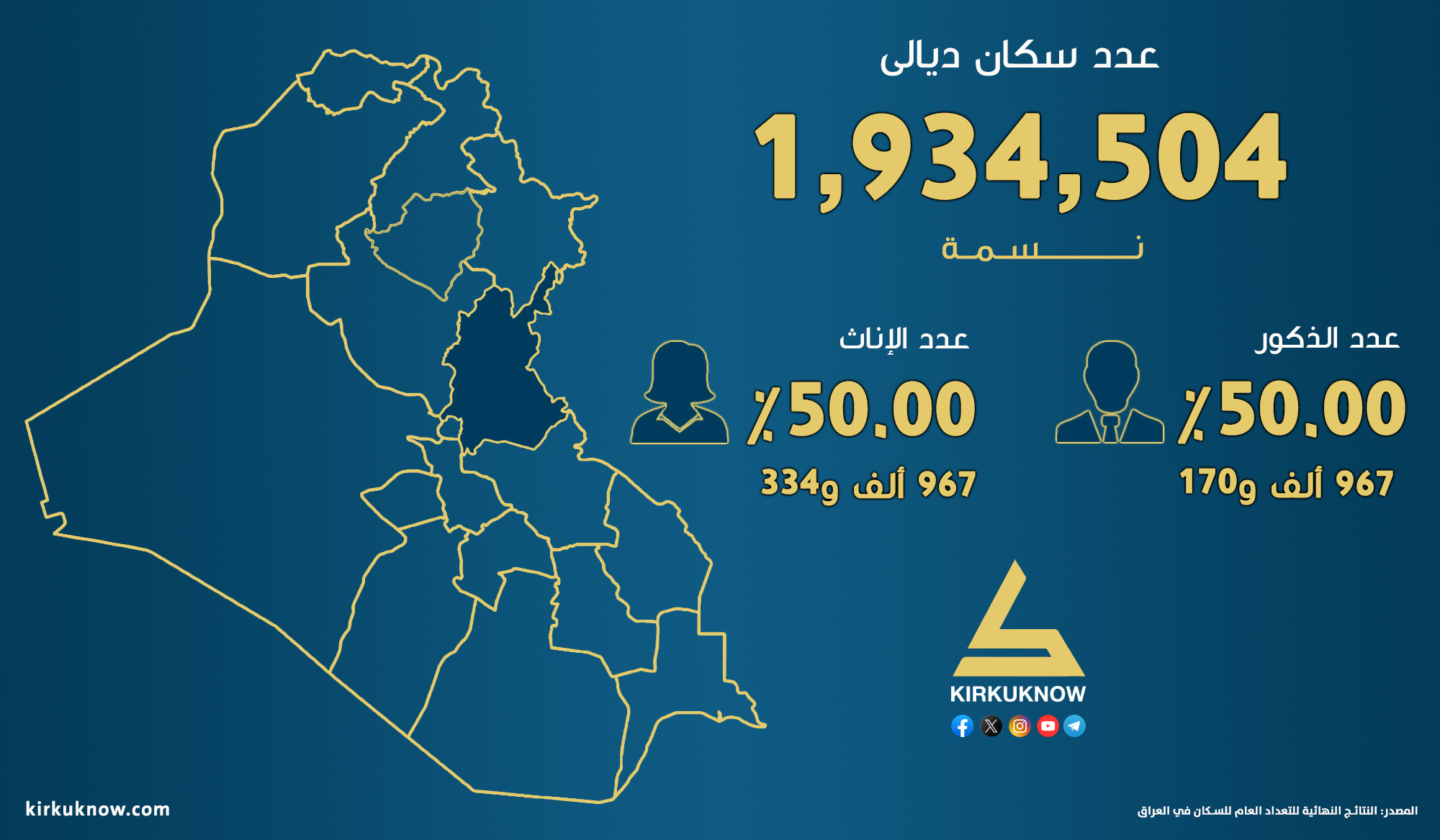
Diyala’s population stands at 1,934,504 (4.2% of Iraq’s total). Nearly half—46.8%—live in rural areas.
Women slightly outnumber men, with 967,334 females and 967,170 males.
The governorate includes eight districts: Baquba (39.02%), Al-Khalis (18.42%), Khanaqin (13.49%), Al-Muqdadiyah (13.15%), Baladruz (6.07%), Al-Mansuriyah (3.87%), Kifri (3.43%), and Mandali (2.55%).
Average household size is 5.83. Men head 87.13% of households, while women head 12.87%, ranking Diyala fourth in Iraq.
Adults aged 15–64 represent the largest demographic at 59.71% (1,155,176). Children make up 36.53% (706,631), and seniors 3.76% (72,697).
Homeownership or living with parents, accounts for 72.87% of residents, 20.75% rent, 4.43% live in free housing, and 1.94% live in government rentals.
Housing units are primarily houses (94.75%), with 4.16% apartments and 1.28% mud-brick homes. About 52% rely on domestic water sources, and over 28% are connected to sewage systems. Waste collection covers 52%, while 24% of waste is burned and 22% treated through other methods.
Salah al-Din: Majority Rural Population
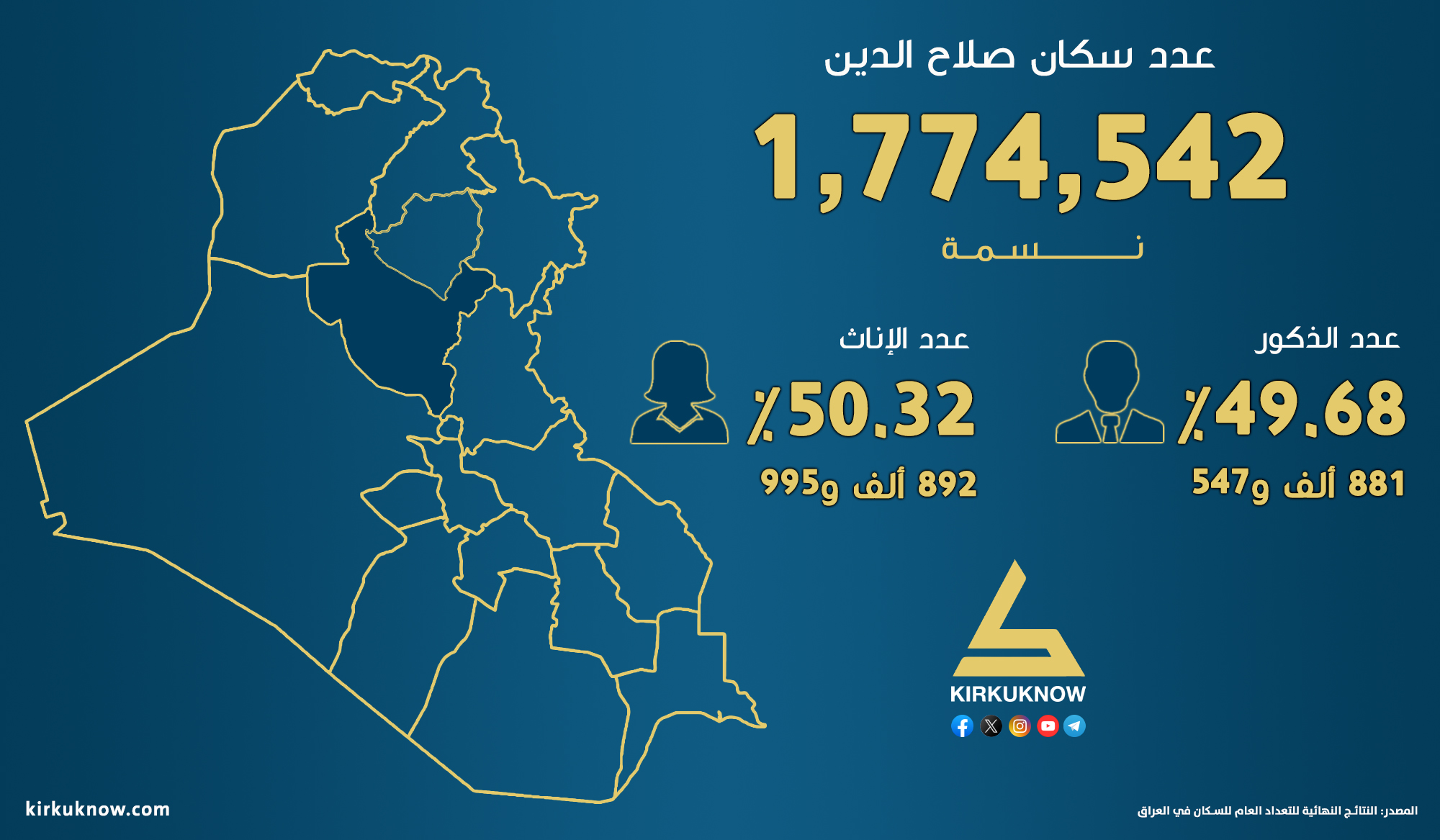
Salah al-Din has 1,774,542 residents (3.8% of Iraq’s population), making it the twelfth-largest governorate. A majority—51.1%—live in rural areas.
Women make up 50.32% (892,995), while men account for 49.68% (881,547).
The governorate includes 11 districts. Unlike most provinces, its largest district is Samarra (17.33%), followed by Al-Shirqat (14.76%) and Tikrit (14.31%). Balad (12.90%), Baiji (10.52%), Tuz Khurmatu (8.3%), Al-Dujail (7.45%), Al-Alam (4.95%), Al-Duluiya (4.92%), and Al-Dur (3.11%) follow. Amerli has the smallest share at 1.46%.
Average household size is 6.43. Men head 89.39% of households; women head 10.61%, ranking seventh nationally.
Working-age residents (15–64) make up 58.50% (1,038,073), followed by children 0–14 at 38.57% (684,481). Seniors 65+ account for 2.93% (51,988).
Most residents (72.86%) own their homes or live with parents; 18.95% rent, 5.57% live in free housing, and 2.63% reside in government rentals.
Housing types include 91.85% houses, 5.13% apartments, and 2.16% mud-brick homes. Over 79% rely on domestic water, and more than 31% are connected to sewage networks. Waste collection covers 56% of the governorate; 20% of waste is burned and the remainder handled through other methods.