



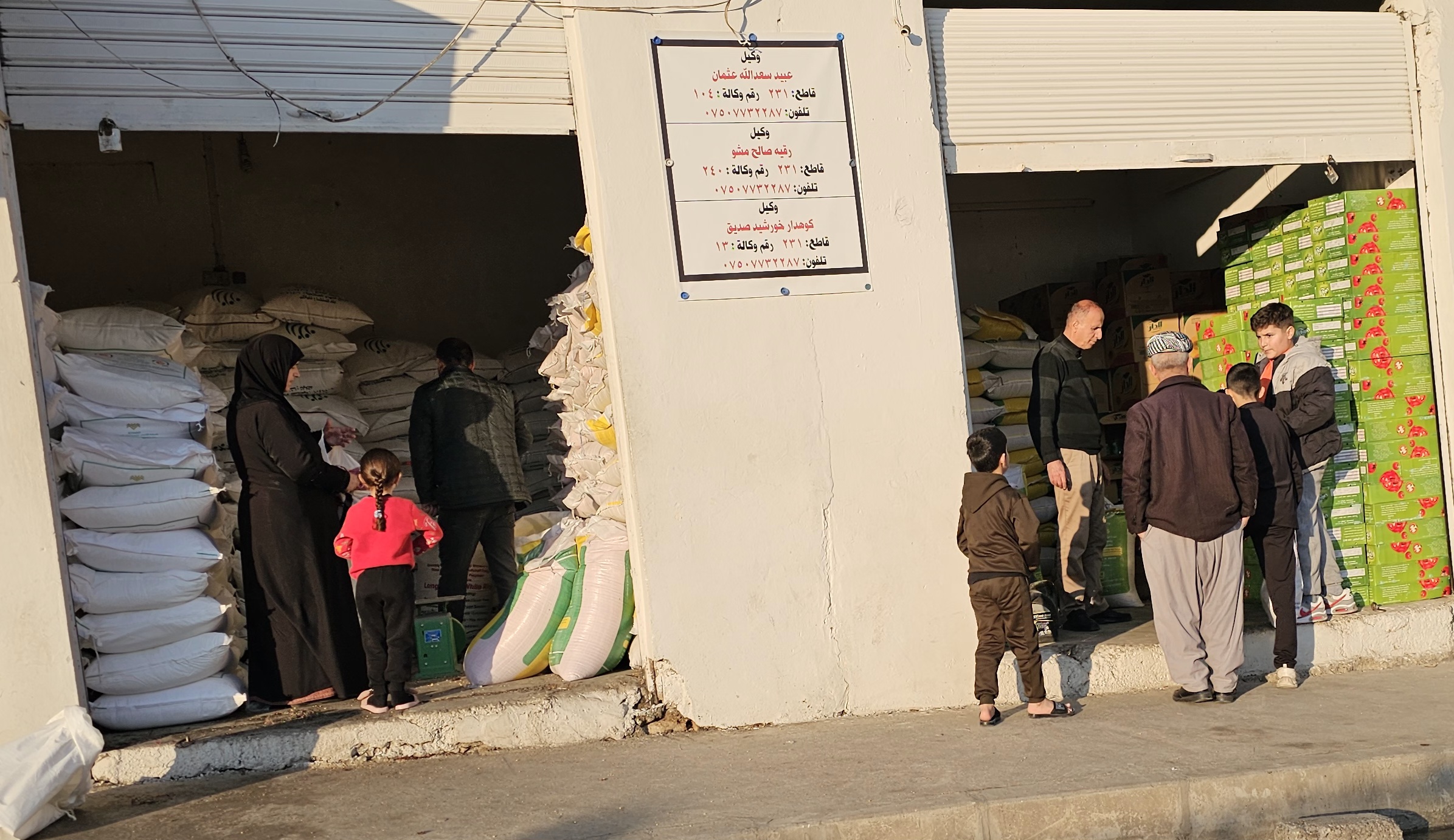

For many residents of Shingal district, completing an official government transaction means traveling 170 kilometers and spending more than 100,000 Iraqi dinars IQD (USD70), a process that has become extremely difficult and frustrating.
Although government offices in Shingal district and nearby districts in Nineveh province process citizens’ paperwork every day, the final step often requires the official stamp and signature of the Shingal mayor or district administrators. Since these officials and their official seals are currently located in Sumel district in Duhok province, residents must travel there to complete their documents.
Hassan Khudeda, a resident of Zorava village in Shingal, described the situation as exhausting. He said that whenever he needs to handle official paperwork, he “feel stressed because must undertake a long and costly trip.”
According to Hassan, if a document requires the signature or stamp of the district mayor, citizens have no choice but to travel to Duhok because the official seal is not available in Shingal.
He recently faced this problem during the summer when he was applying for national identity cards for himself and his family. To finish the process, he had to travel several times between Shingal and Duhok.
The distance from Zorava village to the center of Shingal is about 50 kilometers, while the distance from Shingal to Semel district is approximately 170 kilometers.
“The situation is unfair and has never heard of citizens elsewhere in Iraq being treated this way,” Hassan believes. This problem has been affecting him and hundreds of other Shingal residents for nearly ten years.
The issue dates back to October 16, 2017, when Iraqi forces regained control of disputed territories, including Shingal, following orders from then-Prime Minister Haider al-Abadi. At that time, the Shingal mayor Mahma Khalil and several district administrators affiliated with the Kurdistan Democratic Party (KDP) moved to Duhok province along with withdrawing Peshmerga forces and took the official government seals with them.
Since then, the absence of these seals in Shingal has created continuous difficulties for residents.
Eido Khalaf, originally from Gruzera sub-district of Shingal but currently living in a displacement camp in Duhok, has been trying to complete paperwork to receive compensation for damages caused by ISIS. Because of the administrative situation, he must repeatedly travel between Shingal and Duhok.
He explained that part of his paperwork must be processed in Shingal, but to obtain the required stamp and signature, he must return to Semel district.
“For a single transaction, I spent around 100,000 dinars, and many other residents face the same costs. These difficulties are mainly the result of political disputes.”
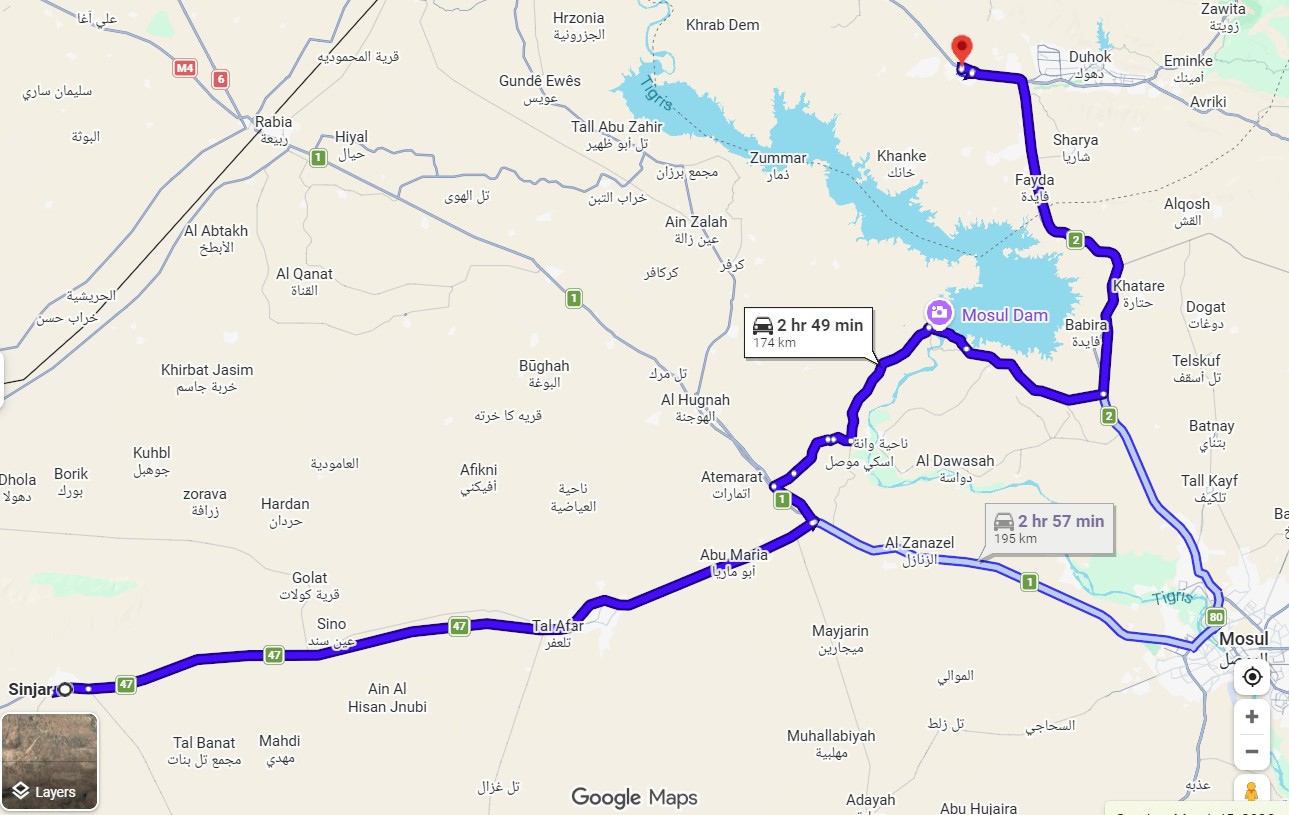
The map indicates that traveling by car from Shingal to Semel takes approximately two hours and forty-nine minutes.
After the events of October 2017, some Shingal residents formed a local self-administration council and appointed their own mayor. However, the Iraqi federal government did not officially recognize this administration, which meant that the authority to sign and stamp documents remained with officials operating from Semel.
In October 2018, the governor of Nineveh ordered local administrators to return to Shingal, but protests by some Yazidi residents prevented the decision from being implemented.
Since April 20, 2023, Jalal Khalaf has been managing certain tasks at the Shingal mayor’s office. However, his authority is limited because he does not possess the official seal, which remains with Naif Saydo in Semel. Saydo describes himself as the acting mayor of Shingal.
Khalaf, who works inside the Sinjar mayoralty office, told KirkukNow that he handles some affairs of citizens, but he does not have a seal.
"I have no authority. Only if a project is opened or an international delegation visits the district, we will welcome them,” he added.
"People must speak out and not accept this. This message has been conveyed to senior Iraqi government officials dozens of times, but to no avail," he said.
People must speak out and not accept this
Most residents of Shingal district are Ezidis (Yazidis), a community that suffered severe losses during the ISIS attack in August 2014, which caused mass killings, kidnappings, displacement, and widespread destruction of homes and infrastructure.
The district is located 120 km west of Mosul and is administratively part of Nineveh province, but is a disputed territory between the two Iraqi federal governments and the Kurdistan Regional Government.
Naif Saydo, who describes himself as the acting mayor of Sinjar, currently lives in Semel district. He holds the official seal and signing authority for the district within Nineveh province. According to him, anyone from Sinjar or Sunune who needs official signatures must travel to Semel.
He explained that they try to make the process easier for some residents. “In certain cases, citizens can send their documents through a private driver from the Sinjar mayor’s office to Semel, where the papers will be signed and stamped before being returned, as long as the owner of the documents does not need to be present.”
Saydo added that when they know someone has traveled from Sinjar to complete a transaction, they try to process the paperwork quickly so the person can return home the same day.
Semel is a district located in Duhok province of the Kurdistan Region, around 170 kilometers from the center of Sinjar.
The Nineveh Provincial Council is responsible for resolving this issue. Two years ago, the residents of Sinjar participated in elections to choose members of the provincial council.
One of the main demands raised by Yazidi voters and other residents of Sinjar during the elections was the appointment of a new local administration for Sinjar district that would operate from within the center of Sinjar.
On July 2, 2024, the Nineveh Provincial Council voted to appoint 20 administrative officials, including mayors and administrators across the province. Among them was Sayyid al-Ahmadi, who was selected as the mayor of Sinjar. However, he has been unable to assume the position because of objections from the Kurdistan Democratic Party (KDP).
Al-Ahmadi stated that all the procedures related to the vote were conducted legally. He emphasized that he meets the necessary requirements, noting that he has no criminal record, has ten years of public service experience, is an independent figure, and received 16 votes from members of the provincial council.
Meanwhile, both the Kurdistan Democratic Party (KDP) and the Nineveh United (Mohada) bloc, which together hold 13 out of 29 seats in the provincial council, declared the voting session illegal. This dispute has been one of the key reasons preventing al-Ahmadi from taking office as the mayor of Sinjar.
Mohammed Jassim, a member of the Nineveh Provincial Council, told KirkukNow that the KDP is blocking the appointment because it believes the position of Sinjar’s mayor should belong to them, even though the council already approved the decision through a vote.
He added that the council is now seeking to resolve the issue through political agreement, stressing that the people of Sinjar cannot continue waiting while public services remain disrupted.
On January 27, 2026, the provincial council again approved several administrative appointments, including a new district director for Gruzer. However, he has not yet assumed his duties, and the official stamp remains in Duhok.
Mohammed Jasim acknowledged that “the situation is primarily political and must be addressed through negotiation or other measures. We are aware of the problem and will continue working with the council leadership to find a solution.”
Naif Saydo also agreed that the matter is political and said that restoring the administration to Shingal requires an agreement among the involved parties.
“About half of Shingal’s population still lives in the Kurdistan Region, which could also complicate the situation.”
For residents like Hassan Khudeda, however, the priority is simple: ending the long journeys and costly procedures required to complete basic paperwork. In his view, solving this problem “would be the greatest service that could be provided to the people of Shingal.”