



Dozens of administrative positions remain under discussion within the Nineveh Provincial Council, as members work to distribute them among the province’s communities based on election outcomes. However, slow progress and competing political demands have stalled the process.
The allocation process began in January 2026, when nine senior posts were approved during a council session. At the time, a vote on 27 additional positions was expected within a month, but that has yet to happen.
“As Kurds, we are aiming to secure 30 percent of the positions in Nineveh, since we estimate that Kurds make up about 30 percent of the population,” Ahmad Kiki, head of the Kurdistan Democratic Party KDP bloc in the council, told KirkukNow.
Kiki noted that three district mayors—Makhmur, Sheikhan, and Shingal (Sinjar)—have already gone to Kurdish representatives out of nine across the province.
This comes as Sinjar, where the majority population is Ezidi (Yazidi), has seen a Yazidi district head selected by the council. However, due to KDP opposition, the appointment has not yet been formalized.
We are aiming to secure 30 percent of the positions in Nineveh
Kurdish parties are also seeking at least seven sub-district-level positions in predominantly Kurdish areas.
Currently, Kurds hold seven out of 29 seats in the council—five belonging to the KDP and two to the PUK—amounting to roughly a quarter of the total seats.
“Although Kurdish representation has decreased, we will try to secure our share of positions through dialogue and agreement,” Kiki added.
Power-sharing arrangements in Nineveh have already assigned the governor’s position to Sunni Arabs, the council speakership to Shiite Arabs, and deputy roles to other communities, including a Christian representative from the Babylon Movement.
The 27 disputed posts include director general roles, as well as advisors and assistants to the governor.
“According to the Council of Ministers, any position held for four years must be reassigned. This includes deputy governors, advisors, and senior administrative roles,” said Eidan Sheikh Kalu, an Ezidi council member.

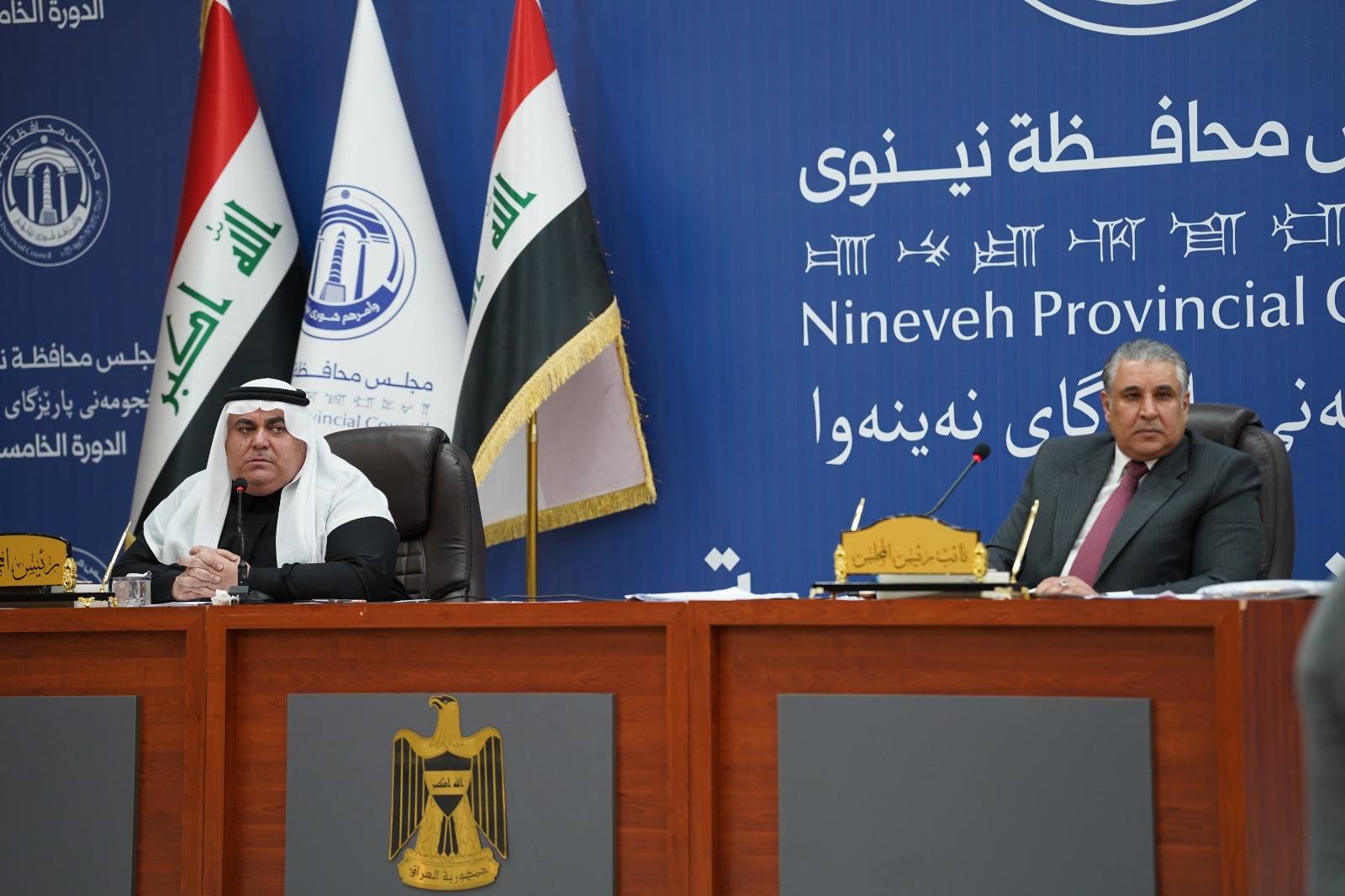
Nineveh, January 27, 2026: An ordinary session of the Nineveh provincial council. Media Department of Nineveh Provincial Council
The Ezidi community has secured several roles, including the mayor of Shingal district, along with assistant positions related to administration and the Displaced affairs, and director of the sub-districts of Sinuny and Gruzer.
However, the Shingal district mayor has yet to assume office due to ongoing disputes. “We will push seriously for an Ezidi to obtain one of the director general positions in Nineveh, which has not happened before,” Eidan added.
We will push seriously for an Ezidi to obtain one of the director general positions in Nineveh, which has not happened before
Despite ambitions from Kurdish and Ezidi representatives to expand their share, council member Mohammed Jassim emphasized that allocations will ultimately reflect seat distribution.
In previous elections, Kurds held 14 out of 39 seats (36 percent), but this dropped to seven seats (24.5 percent) in the December 2023 vote.
Minority groups—including Christians, Shabaks, and Ezidis—collectively hold three seats, about 10 percent of the council. Arab representatives, both Sunni and Shiite, make up 65.5 percent.
Some minority candidates ran within broader coalitions, including Ezidis, Shabaks, Christians, and Kakais.
Jassim explained that unresolved positions have been divided into two groups: those transferred to provincial authority, including four director general roles sought by Kurds, and those still under ministerial control—such as education, health, police, and investment—along with five deputy governor roles and five advisory positions.
Competition over these posts remains intense. Although the council was expected to finalize decisions quickly, negotiations continue two months later.
“Minority positions are relatively stable due to their geographic concentration and political backing, though some are aligned with larger parties,” Jassim said, citing examples such as Hamdania and Alqosh.
Even within the Kurdish side, there are divisions among different factions
Ezidis, concentrated in Shingal, continue to push for representation in their areas but face internal divisions, similar to other minority groups.
“Even within the Kurdish side, there are divisions among different factions, which has complicated the process,” Jassim added. “Multiple groups within each community are competing for positions. For instance, we sought three district posts in Sinjar and Makhmur but secured only one due to disagreements.”
Although the council initially planned to finalize all appointments within a month, it has convened only twice since December without resolving the outstanding positions.
“The limited number of meetings is partly due to instability in the region, which has affected decision-making. Political agreement and coordination among parties remain key to resolving the issue,” Jassim said.