



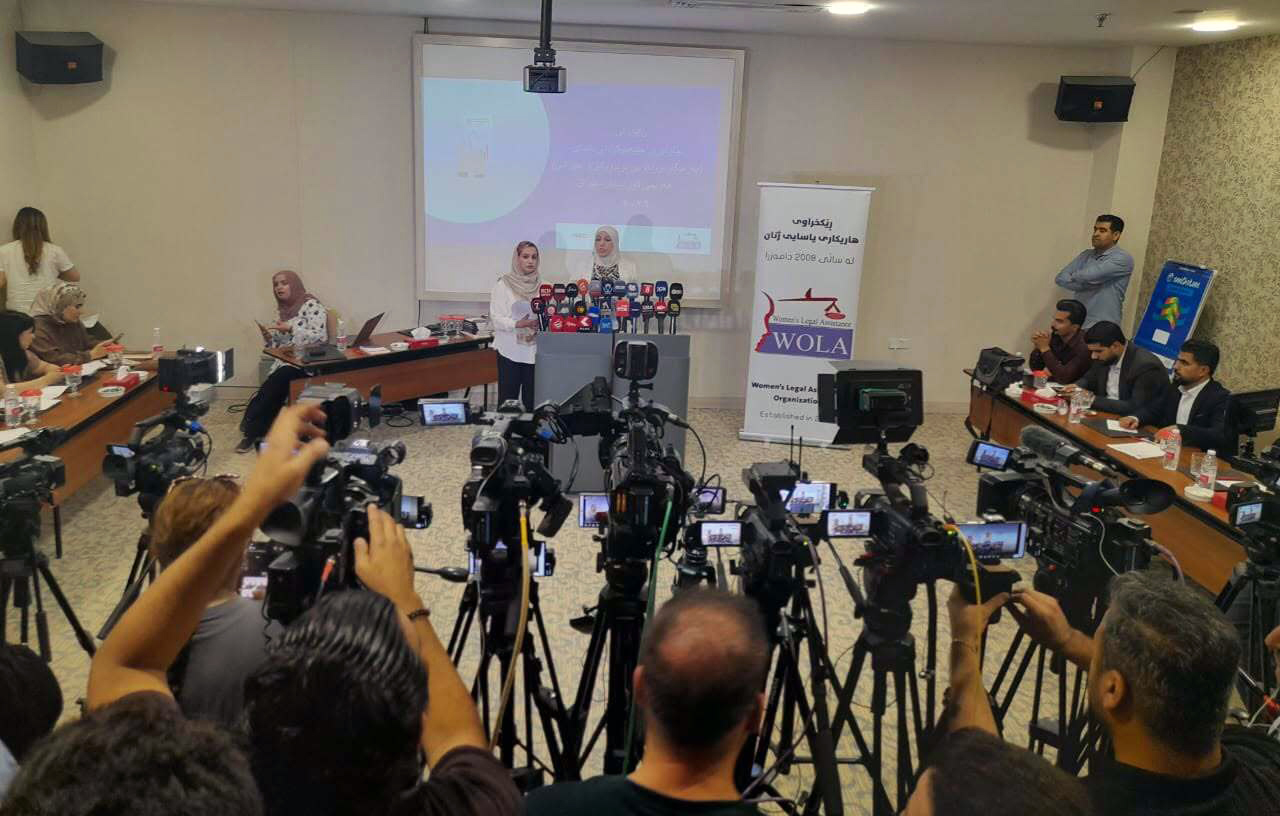

The Women's Legal Aid Organization (WOLA) presented the findings of a new report on the implementation of the Iraqi Kurdistan Region's Anti-Domestic Violence Law during a press conference held in Sulaimaniyah.
Conducted in partnership with the National Endowment for Democracy (NED), the survey examined public perceptions of domestic violence and the enforcement of the anti-domestic violence law. The results, released on June 20, 2026, indicate that psychological and financial abuse are the most widespread forms of domestic violence, while increasing legal and social awareness was identified as the most effective strategy for addressing the issue.
The survey included participants aged 18 and older. When asked about the confidentiality of court investigations in domestic violence cases, 74.35% believed the procedures are confidential, whereas 25.33% thought they are not.
Psychological violence was identified by 41% of respondents as the most common form of domestic abuse. Physical violence followed at 19.5%, while 5.5% of participants considered sexual violence to be the most prevalent.
More than half of respondents (52.45%) identified husbands as the primary perpetrators of domestic violence. Fathers ranked second at 19.67%, followed by brothers at 12.02%. Mothers were identified by 5.46% of respondents, while no participants identified sisters as perpetrators within the family.
Regarding responses to domestic violence, 57.31% said they would file a formal complaint. One-quarter of respondents indicated they would remain silent, while 9.75% would contact emergency hotlines and 7.92% would seek support from specialized organizations.
Nearly half of participants (49.14%) believed that improving legal and public awareness would be the most effective way to reduce domestic violence. Religious leaders were viewed as the next most influential factor by 21.14% of respondents, followed by premarital counseling (16.75%) and media and social media awareness campaigns (13.14%).
Support for institutional measures was also strong. A majority (54.19%) believed shelters are necessary for victims of domestic violence, while 45.80% disagreed. Additionally, 78% supported the creation of specialized domestic violence courts, 10.96% considered them somewhat necessary, and only 1.93% opposed the idea.
The WOLA report also presented judicial statistics for 2025. Courts across the Kurdistan Region of Iraq KRI registered 61,328 marriage contracts, including 25,687 in Sulaimaniyah, 19,620 in Erbil, 12,955 in Duhok, and 3,066 in Kalar.
The report recorded 107 legally authorized second marriages, including 42 in Erbil, 39 in Sulaimaniyah, and 26 in Duhok.
During the same year, 15,826 divorces were registered across the region. Erbil accounted for 7,113 cases, followed by Sulaimaniyah with 5,369, Duhok with 2,354, and Kalar with 990.
To strengthen implementation of the Anti-Domestic Violence Law, WOLA recommended providing legal representation for victims, ensuring the enforcement of protection orders throughout the region, establishing specialized domestic violence courts, creating a dedicated family affairs office in Halabja, opening a family court in the Raparin administration, and working with the Bar Association to recruit and support lawyers handling family and domestic violence cases.