



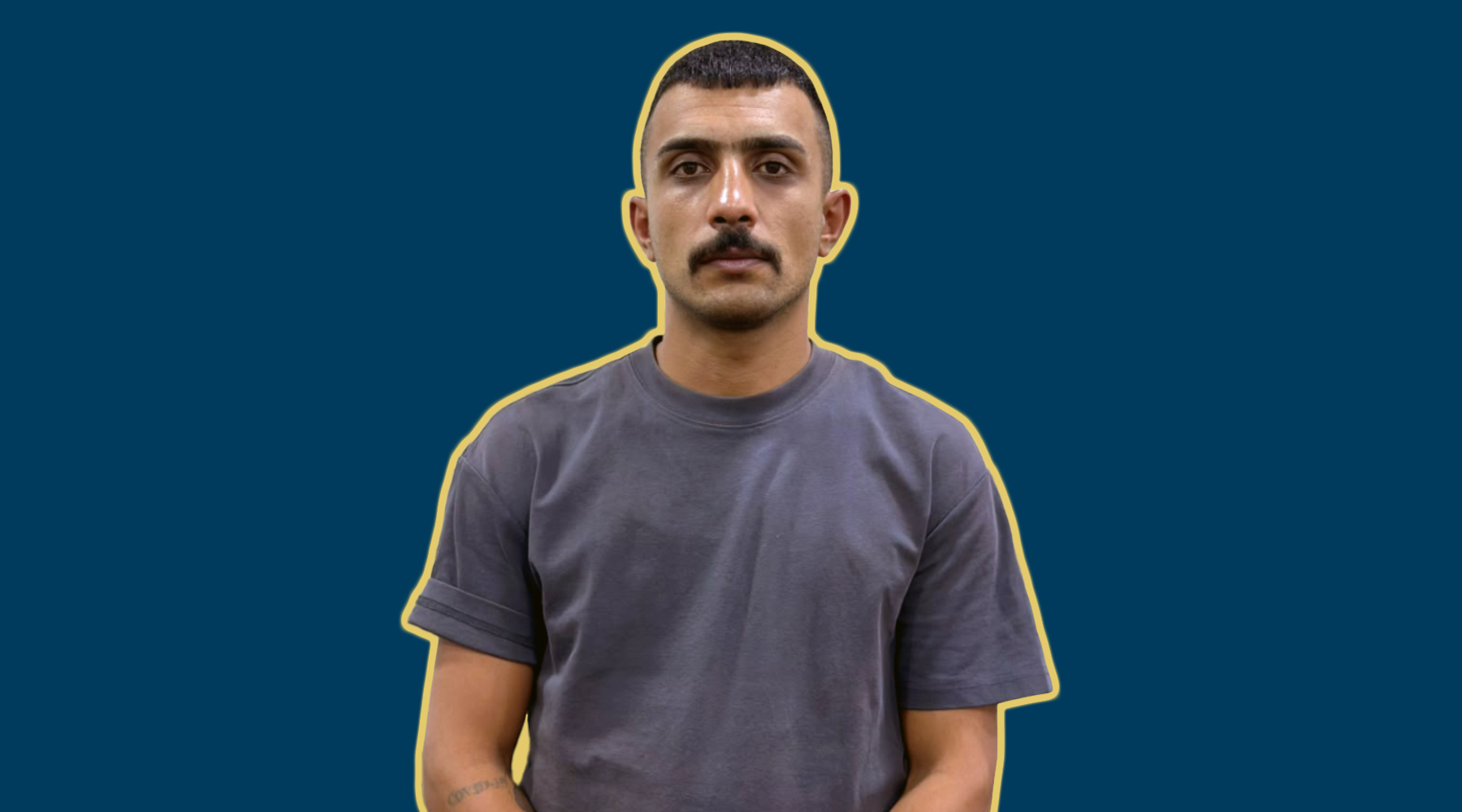

A young Kaka’i man arrested last week in Khanaqin district of Diyala province, has described what he says was severe physical and psychological torture while being held at an intelligence facility in Diyala.
Rebin Star, also known as Rebin Blacksmith, said he was beaten with cables, held in solitary confinement, subjected to electric shocks, and pressured to sign a confession. His account is supported by a forensic medical report issued by the Ministry of Health of the Kurdistan Regional Government, a copy of which was obtained by KirkukNow.
Arrest after changing a shop sign
Rebin’s ordeal began on August 26, after he changed the sign outside his blacksmith shop. The original sign had been written only in Arabic; he changed it to include both Kurdish and Arabic.
“I wanted everyone to know that Khanaqin is Kurdish,” he said in a video posted on social media.
Khanaqin witnessed a week of heightened security tensions, protests and threats against activists in Khanaqin following a debate over the use of Arabic on shop signs. Rebin was reportedly the first person to launch a campaign encouraging shop owners to use both Kurdish and Arabic.
Rebin, 29, is married and has two children, three-year-old Avesta and 11-month-old Arin. He runs a small blacksmith workshop in Khanaqin and had been active on social media in support of bilingual signs.
Four days later, on the morning of August 30, Rebin received a phone call from a man speaking Kurdish who asked him to come and carry out some blacksmithing work. Rebin said he was busy and would call later.
They hit me on the head, tore my T-shirt and beat me
“I did not know him. I called him in the evening and was waiting in front of Rasan City when a black pickup stopped beside me. They hit me on the head, tore my T-shirt and beat me,” he said.
According to Rebin, the men told him he was being arrested on terrorism charges and took him to the counter-terrorism intelligence department in Khanaqin.
KirkukNow reported that Rebin was arrested under Article 200 of the Iraqi Penal Code, which concerns acts including spreading hatred, promoting ideas intended to undermine the constitutional or social order, and inciting religious or ethnic conflict.
Khanaqin is part of the multi-ethnic disputed territories which are closely tied to Article 140 of the Iraqi Constitution, a three-step process for determining the status of Kirkuk and other disputed territories. The process includes normalization, a population census, and a referendum.
Under the normalization phase, families who are not originally from Kirkuk—often referred to as "newcomers / settlers"—would be expected to return to their areas of origin. At the same time, families displaced during the Ba'athist era would be allowed to return to Kirkuk and other disputed territories, with compensation provided to both those returning and those relocating.
Although the Constitution set the end of 2007 as the deadline for implementing Article 140, the normalization stage was never completed. In 2019, Iraq's Federal Supreme Court reaffirmed that the article remains valid until all constitutional procedures are fully carried out.
From Khanaqin to Diyala
Rebin said he was initially questioned at the counter-terrorism intelligence facility in Khanaqin, where several security agencies operate. He was then told that the director of the national Iraqi Intelligence Service in Diyala wanted to question him.
“They blindfolded me and drove me to the Federal Intelligence and Investigation Agency in Diyala province,” he said.
The agency, affiliated with Iraq’s Interior Ministry, is headquartered in Baquba.
Rebin said that upon arrival he was photographed and tortured before being questioned.
“They beat me with cables under my feet for about an hour. I was screaming in pain. I asked why they were beating me, but nobody answered, and I was still blindfolded,” he said.
They beat me with cables under my feet for about an hour
Afterward, he said, he was placed in solitary confinement.
“The room was about 1x1 meter only. It was dark, with an iron door and no light or sunlight. Even though my eyes were open, I could not see anything,” Rebin said.
About an hour later, according to his account, he was blindfolded again and taken to another room where five or six people were present.
“They told me they would uncover my eyes, but warned that if I looked at them, they would hurt me. They put my head on the ground, insulted me, tied my hands and wrapped me in a blanket,” he said.
Changing accusations
Rebin said his interrogators initially accused him of being an Islamic State (ISIS) fighter and of killing his cousin. He denied both allegations and said that ISIS had actually killed one of his cousins.
He said the accusations later changed. Investigators allegedly accused him of providing information about Popular Mobilization Forces (Hashd al-Shaabi) headquarters to Israel. Rebin denied that allegation as well.
According to his account, the interrogation then involved electric shocks.
“I heard the sound of the electric shock and I was really scared. I thought my heart would stop. They shocked me and I screamed,” he said.
Rebin said the focus of the questioning eventually shifted from the terrorism allegations to the sign outside his shop.
“Why did you change the sign on your shop?” the investigators asked.
“At that moment, I realized that the whole matter and my arrest were connected to changing the sign on my shop,” Rebin said.
“I am a blacksmith. I have not committed any crime. I only added Kurdish (script) to the sign; the Arabic remained.”
He said the investigators accused him of encouraging other people and demanded to know who had supported him in what they described as an attempt to destabilize Khanaqin.
I have not committed any crime. I only added Kurdish (script) to the sign; the Arabic remained
Alleged forced confession
Rebin said the torture intensified after he continued denying the allegations. He described being subjected to further abuse, including electric shocks.
He also said investigators placed a plastic bag over him and threatened to pull his teeth. According to Rebin, he eventually lost consciousness.
A medical report dated September 3 and signed by a doctor, with a stamp from Rizgari Hospital’s police station, reportedly documented injuries. The report noted burn marks appearing as black spots on his genital organ, as well as signs of injury to both legs and the soles of his feet.
Rebin said investigators pressured him to “tell the truth,” while he continued insisting that his statements were accurate.
He said they eventually demanded that he confess that Karwan Yarwais, head of the Patriotic Union of Kurdistan’s (PUK) headquarters in Khanaqin, had paid him to encourage demonstrations.
My hand and arm were dislocated
“I agreed. They opened my eyes, wrapped me up and took my fingerprints,” Rebin said.
He said he was then subjected to further abuse. According to his account, "one hand and arm were dislocated as a result."
Rebin also described other forms of humiliation, including ethnic insults and having shoes placed on his head.
The medical report
The forensic report cited by KirkukNow recorded signs of physical injury. It described marks on both legs and beneath the feet and attributed the injuries to external pressure.
KirkukNow attempted to obtain comments from other security authorities in Diyala but received no response. Security officials in Khanaqin confirmed that Rebin had been arrested by Iraq’s Federal Intelligence and Investigation Agency.
Rebin’s father told the media that his son had been transferred from Baquba to another location despite, in his view, having done nothing more than add Kurdish to a sign that had previously been written only in Arabic.
Tensions in Khanaqin
Khanaqin, a city known for its mixed Kurdish, Arab and Turkmen population, experienced heightened political and security tensions during the week of Rebin’s arrest.
The tensions were linked to political disputes, statements exchanged between rival parties through traditional and social media, questions surrounding demographic changes, restrictions on political activity, and the implementation of Article 140 of the Iraqi Constitution.
Karwan Yarwais, the head of the PUK headquarters in Khanaqin, had discussed developments in several parts of Diyala province during a television appearance on Rudaw. His remarks prompted strong reactions from Arab political groups in the area.
Rebin said he endured both physical and psychological suffering during the two nights he spent in custody.
Our position is against changing the demographic makeup of the region
“There has been a misunderstanding regarding the demands of the people of Khanaqin,” said Karzan Hmadan, one of the organizers of the protests. “Our Arab brothers have interpreted these demands as opposition to Arabs, but that is not what we mean. Our position is against changing the demographic makeup of the region.”
“We oppose demographic changes in the region and are calling for the preservation of Khanaqin’s identity,” he added.
Hmadan said activists were also concerned by reports that dozens of people had been arrested. “We have received information that dozens of people have been detained, which has prompted a number of activists in Khanaqin to leave the city and seek refuge in the Kurdistan Region,” he said.
Appearance before a judge
On August 31, Rebin was taken before a judge. He said that before leaving the prison for the court, he was warned not to withdraw or change the confession he had signed and fingerprinted. Despite this warning, Rebin said he hoped the judge would order his release.
No one was permitted to accompany him into the judge’s room.
“They uncovered my eyes outside the judge’s door, and I went inside. I was deeply distressed, but I believed the judge might be able to save me from further torture,” Rebin said. He told the judge that he had been severely beaten and forced to provide his fingerprints under torture. He also pointed to the Qur’an and said the confession had been prepared by the investigators rather than given voluntarily by him.
Rebin said he attempted to demonstrate the injuries he had sustained by asking to show the judge the marks left by the electric shocks. According to his account, however, the judge said this was not necessary.
I was struggling to breathe and crying as I spoke. The judge asked me to sit down and instructed a guard to bring me some water
“I was struggling to breathe and crying as I spoke. The judge asked me to sit down and instructed a guard to bring me some water,” Rebin recalls.
He said that after the hearing, he was returned to the same prison. Under Article 200 of the Iraqi Penal Code, a person who advocates ideas intended to alter the fundamental principles of the constitution or social order, seeks to establish the dominance of one social group over another, or works to undermine the social system may face imprisonment for up to seven years.
The article also applies to those who encourage the overthrow of Iraq’s existing system or promote hatred and ideas that contribute to religious, sectarian, or ethnic conflict, with the same penalty provided under the law.
Release on bail
Rebin said he was given food on the evening before his release but was unable to eat some of it. He described spending the night awake and speaking to a blanket as though he were talking to his young daughter.
“I could not sleep because of the pain from the torture,” he said.
He said he was not physically tortured again that night. On the morning of September 1, officials once again recorded his personal information and kept him waiting.
At 12:20 p.m., the prison doors opened and Rebin was released on bail.
His release had been one of the demands raised by activists in Khanaqin, who subsequently suspended demonstrations concerning the alleged violations and broader tensions in the city. Their demands were also taken to Baghdad and the Iraqi president.
“When I left the prison, I had forgotten that I was not wearing shoes until they called me back to put them on,” Rebin added.
He said that before his release, officials warned him not to speak publicly about what had happened and threatened him with further consequences.
Despite his experience, Rebin said he was encouraged by the support he received after returning home, particularly on social media.
He has not filed a formal complaint, despite possessing a medical report documenting injuries.
“No one has advised me yet about what I should do. I do not know what will happen to me or my family,” he said. “I ask human rights organizations and the government to intervene.”
“Treat everyone in Iraq equally. Stand with me like an elder brother and restore my rights,” he called upon the Iraqi Prime Minister.