


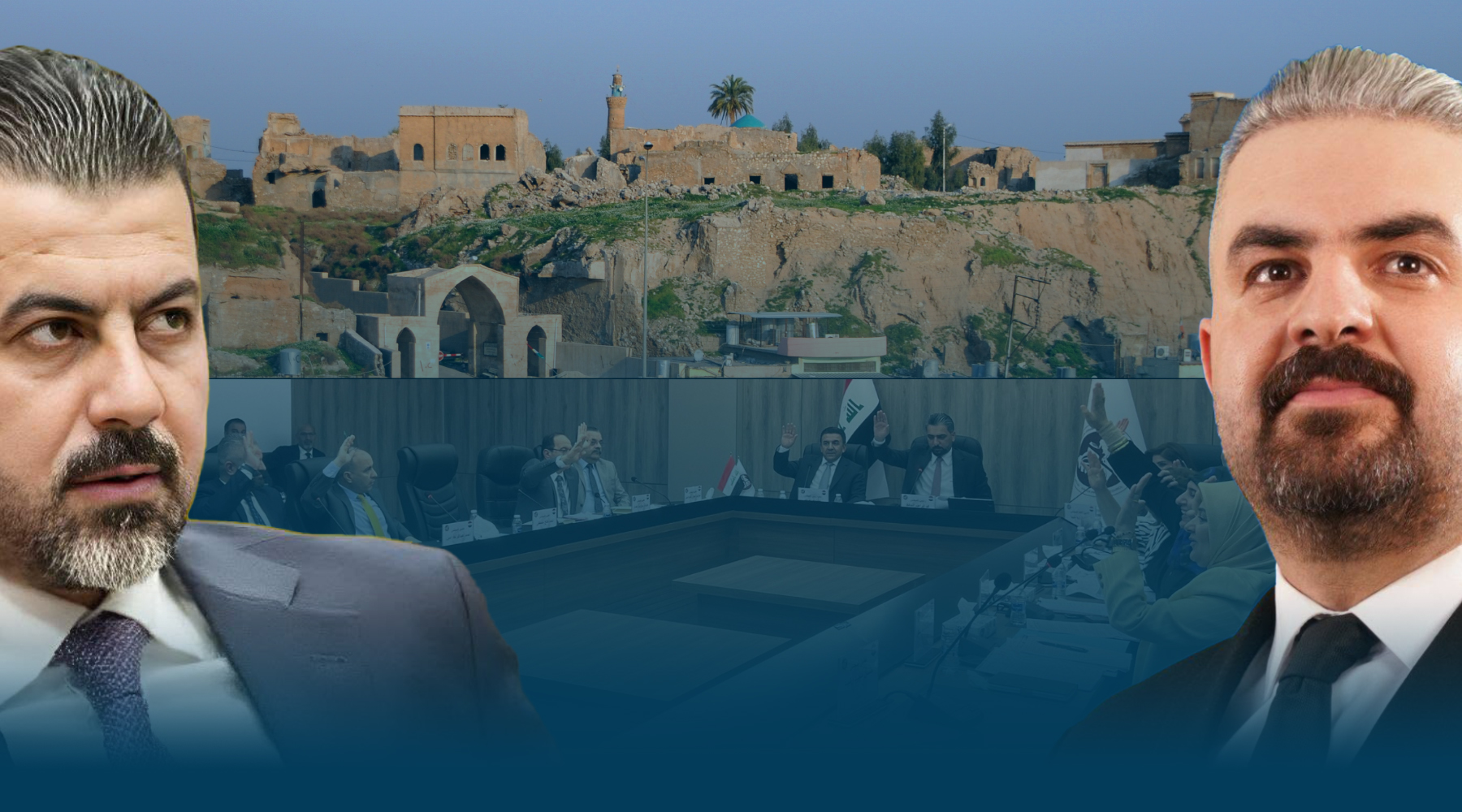

A new political dispute has emerged in the northern, oil-rich, multi-ethnic province of Kirkuk between Arab and Turkmen representatives over employment representation within the province’s Health Department.
The controversy centers on calls for greater administrative balance among Kirkuk’s ethnic groups and has reignited broader debates about power-sharing in local government institutions.
The issue began when Iraqi lawmaker Muhaymin al-Hamdani of the Progress Bloc sent a letter to the Speaker of Parliament on June 9, 2026, requesting the formation of a ministerial committee to review staffing and administrative representation within the Kirkuk Health Department. His proposal aims to preserve what he described as “functional balance” and ensure equitable participation among the province’s ethnic communities.
In his letter, which received parliamentary approval, al-Hamdani stated that Turkmen account for 54 percent of positions within the Health Department, Kurds 39 percent, and Arabs only 7 percent. However, he did not specify whether these figures referred to senior administrative roles or the department’s entire workforce, nor did he cite the source of the data.
The Kirkuk Health Department is currently headed by a Turkmen official, adding further significance to the debate.
Longstanding Disputes Over Power-Sharing
Disagreements over the allocation of government positions in Kirkuk are not new. Despite Article 35 of Iraq’s Provincial Councils Elections Law No. 12 of 2018, which requires fair representation of all communities regardless of election outcomes, disputes over political and administrative appointments continue.
Al-Hamdani argues that Arabs are underrepresented in the Health Department and has called for corrective measures to ensure equitable distribution of jobs and leadership positions among all ethnic groups.
The broader issue of ethnic quotas has also affected public administration. According to previous reporting by KirkukNow, disagreements over representation have contributed to delays in implementing more than 7,000 contract-based employment opportunities approved under the federal budget.
Turkmen Response
Ahmed Ramzi, a member of the Kirkuk Provincial Council representing the Iraqi Turkmen Front (ITF), responded publicly to al-Hamdani’s proposal on Facebook the same day. Using a traditional Arabic proverb, Ramzi suggested that al-Hamdani lacked a full understanding of local realities.
While welcoming efforts to address representation, Ramzi argued that any review should extend beyond the Health Department and include all government institutions. He pointed to what he described as uneven distributions across various sectors, noting that Turkmen hold many positions in the Health Department, Arabs dominate leadership roles within the Kirkuk Police Command, and Kurds occupy a significant share of positions in the municipality.
Political Context
The dispute comes at a sensitive political moment. The Turkmen Front, the Progress Party, and the Patriotic Union of Kurdistan (PUK) are key partners in the current local governing arrangement in Kirkuk.
Under a power-sharing agreement, the governorship rotated to a Turkmen official in April 2026. The Turkmen Front also secured leadership of two Provincial Council committees, including the Balance Committee. At present, Kirkuk’s governor is Turkmen, while the two deputy governors are Kurdish and Arab, respectively.
Among the province’s four district administrations, Kurds oversee Kirkuk city and Daquq, while Arabs administer Dibis and Hawija. Together, these three communities control most senior government positions throughout the governorate.
During the Ba'athist regime, most key positions of power in Kirkuk were held by the Arab community without any elections. After 2003, the Kurds assumed executive power until 2017. The Arab community regained the governorship when al-Jiburi, the deputy governor, was appointed governor of Kirkuk. The Kurds then reclaimed the position in 2024 with the appointment of Taha as governor. Currently, the position is held by a Turkmen.
Christian Representation
Christians, despite being one of Kirkuk’s principal communities, remain less represented in provincial administration. Their participation is largely limited to the position of Director of Buildings and Projects, along with a small number of advisory and assistant roles, according to previously published statistics.
Ongoing Administrative Reforms
The latest controversy coincides with efforts to restructure leadership positions within government departments. In May 2026, the Provincial Council voted to replace department directors who had served more than four years, whether in acting or permanent capacities. Under the plan, replacements must come from the same ethnic group while also meeting professional and integrity requirements.
Ramzi argued that a comprehensive review of all government institutions would demonstrate a genuine commitment to fairness and equal treatment for every community in Kirkuk.
At the same time, Arab political blocs within the Provincial Council have recently coordinated their efforts, declaring that they aim to safeguard the rights and political representation of Kirkuk’s Arab population.
Provincial Council Chairman Mohammed Ibrahim al-Hafiz previously acknowledged that Arabs currently hold more positions than they did in the past.
The 16-seat Kirkuk Provincial Council is distributed among several groups: Arabs hold six seats across three blocs, Kurdish parties control seven seats (five held by the Patriotic Union of Kurdistan PUK and two by the Kurdistan Democratic Party KDP), the Iraqi Turkmen Front ITF holds two seats, and the remaining seat belongs to the Babylon Movement representing the Christian community.
A Challenge Decades in the Making
For more than two decades, both the Iraqi federal government and Kirkuk’s local administration have attempted to establish a stable system of representation among the province’s ethnic and religious groups. Numerous committees and policy initiatives have sought to achieve this balance, but no lasting solution has been reached.
Following the fall of Saddam Hussein’s regime in 2003, a proposal advanced by the late Iraqi President Jalal Talabani allocated administrative positions in Kirkuk according to a formula of 32 percent each for Kurds, Arabs, and Turkmen, with 4 percent reserved for Christians. The Kirkuk Provincial Council approved the arrangement in July 2009, although it primarily applied to senior administrative positions rather than all government employment.
Historically, key positions in Kirkuk were dominated by Arabs during the Ba’ath era. After 2003, Kurdish parties largely controlled executive authority until 2017, when Arabs regained the governorship. The position returned to Kurdish leadership in 2024 before being transferred to a Turkmen governor under the current power-sharing arrangement.
A Disputed Province
Kirkuk, with a population exceeding two million, remains one of Iraq’s most contested territories. Both the federal government and the Kurdistan Regional Government KRG claim authority over the province. Its final political status is tied to the implementation of Article 140 of the Iraqi Constitution, which calls for normalization measures, a population census, and a referendum to determine the future of the disputed territories.