



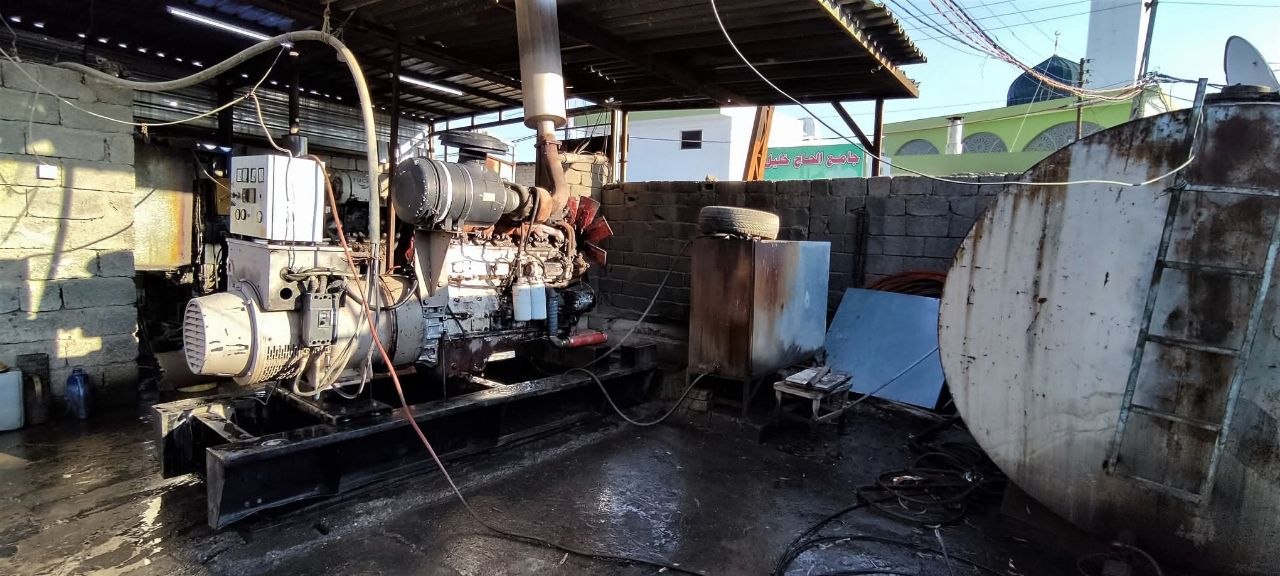

Private generator owners in Kirkuk are threatening to shut down their generators, while government offices across the province have begun reducing operations amid a worsening diesel shortage, rising prices, and difficulties obtaining fuel on the black market.
Since last week, owners of private generators—which provide around 50% of Kirkuk’s electricity—have warned that they may halt operations, saying the government’s subsidized diesel monthly allocation is only enough to operate their generators for about two weeks.
Details of the Crisis
The crisis has been driven by difficulties obtaining commercially available diesel and a sharp increase in its price. The government allocation provided to private generators is also insufficient to cover their needs for an entire month.
Adham Ahmed, a private generator owner in Kirkuk, told KirkukNow, “Previously, when our government-allotted diesel ran out, we would purchase commercial fuel at higher prices. Now, however, its price has increased significantly and it has become difficult to obtain.”
He said generator owners had raised the issue with the Kirkuk governor and district commissioner, but no solution had been reached.
Under growing pressure, generator owners have threatened to shut down their facilities as a means of pressing authorities to act. They have given the Kirkuk administration until the end of the week to increase their fuel allocations.
The Kirkuk branch of the Oil Products Distribution Company currently provides generator owners with 45 liters of Diesel per kilowatt (kW). A source within the company said this allocation has remained unchanged.
The source, who spoke on condition of anonymity because he was not authorized to speak to the media, said, “We do not have the authority to increase the generators’ allocation, as that depends on an increase in Kirkuk Governorate’s overall allocation.”
Regarding the shortage and rising price of commercial Diesel, the source said, “As far as we know, several companies have stopped production, but we do not know the reason.”
The price of a barrel (220 liters) of diesel in Kirkuk has risen to 220,000 Iraqi dinars IQD (USD150), representing a 40% increase compared with two months ago.
The northern, oil-rich, multi-ethnic Kirkuk Province, home to more than 2.34 million people, remains one of Iraq’s disputed territories between the federal government and the Kurdistan Regional Government. Its future status is tied to Article 140 of the Iraqi Constitution, which outlines a process involving normalization, census-taking, and public referendums.
Kirkuk Governor Mohammed Samaan expressed concern last week over the fuel shortage, which has also affected government offices. Some departments have been forced to shut down their generators at times despite temperatures exceeding 45°C, making it difficult for offices to process public transactions without electricity.
An employee at one government department told KirkukNow, “The main concern of department heads has become securing fuel for generators through their personal connections.”
Samaan said he had asked several private fuel production companies in Kirkuk to assist in supplying diesel to government offices and had also contacted the Ministry of Oil. The crisis, however, remains unresolved. “I am securing diesel for the people of Kirkuk,” he said.
Following the 1991 Gulf War, Iraq's infrastructure suffered significant damage, while the economic sanctions imposed on Saddam Hussein's regime further weakened the country's electricity system. Damage to transmission lines and substations left the state unable to provide adequate basic services.
Several years later, local authorities authorized the installation of private diesel generators in residential neighborhoods to help compensate for shortages in the national power supply. At the time, the state electricity network was able to meet only about half of the country's electricity demand, making private generators an essential source of power for many residents.
Kirkuk governorate requires more than 1,000 megawatts of electricity each day to meet the needs of its residents, but currently receives only around half of the required amount.
To help address the shortage and compensate for limited hours of national grid supply, the governorate administration relies on 733 privately operated diesel generators.
What Is Causing the Diesel Crisis?
Officials at the Kirkuk branch of the Oil Products Distribution Company have attributed the decline in supplies to the suspension of production by some companies. However, a source within the Kirkuk administration linked the shortage to the disruption of diesel smuggling into the province through checkpoints.
The source, who also requested anonymity, said, “Procedures have been tightened at checkpoints, particularly the Darman checkpoint, which was being used to smuggle Diesel into Kirkuk.”
The tightening of controls comes amid an anti-corruption campaign in Iraq. Security forces have arrested at least 30 officers and personnel in Kirkuk on allegations of accepting bribes. According to the Integrity Commission and security agencies, some checkpoints had facilitated the passage of smuggled fuel shipments in exchange for bribes.
In 2025, Iraq’s Federal Commission of Integrity (FCOI) received approximately 14,500 new corruption reports, in addition to 22,500 unresolved cases carried over from previous periods, bringing the total number of cases to around 37,000. The commission processed nearly 32,000 of these cases, representing an achievement rate of about 85%.