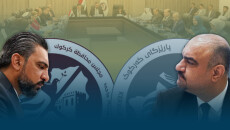
The lack of an explicit legal provision addressing vacancies in the governor’s office has triggered a dispute between the governor of Kirkuk Mohammed Saman and Rebwar Taha his first deputy, as political and administrative authorities await formal procedures to determine the future of the position.
The controversy emerged after Saman was sworn in as Minister of State in the government of Ali al-Zaidi on Thursday, October 15, 2026. Following his appointment, First Deputy Governor Rebwar Taha announced that he had begun performing the governor’s duties in an acting capacity, citing what he described as an administrative vacuum in Kirkuk.
At the heart of the dispute is the fact that Saman has not formally resigned as governor, leaving questions about whether he legally retains the position and whether Taha has the authority to take over its responsibilities temporarily.
What Does the Law Provide?
Article 28 of the Law on Governorates Not Organized into a Region, Law No. 21 of 2008, as amended, addresses circumstances in which a governor becomes unable to perform their duties for health reasons for more than three months. In such cases, the governor is to be retired, and the provincial council must elect a successor in accordance with the legal procedures. Until a new governor is elected, the first deputy assumes the governor’s responsibilities.
However, this provision specifically concerns health-related incapacity and does not explicitly address every circumstance that could result in a vacancy, including resignation, death, dismissal, or the loss of legal capacity.
Article 7, Paragraph Seventh, Subparagraph 1, meanwhile, requires the election of a governor within 30 days of the provincial council’s first session. Nevertheless, applying this provision to an unexpected vacancy raises further questions, particularly regarding the authority responsible for managing the governorate until a successor is elected.
The absence of an explicit provision covering all possible scenarios has therefore contributed to the current legal uncertainty.
The distribution of senior positions reflects Kirkuk’s complex political and ethnic balance. The governor is currently Turkmen, while his two deputies are divided between Kurdish and Arab representatives.
Of the governorate’s four district commissioners, two are Kurdish—Kirkuk Center and Daquq—and two are Arab—Hawija and Dibis. Government Departments is similarly distributed primarily among the three major communities.
Christians, despite being one of Kirkuk’s established demographic groups, hold comparatively few senior administrative positions.
Why Are the Two Sides Disagreeing?
A source within the Kirkuk Provincial Council told KirkukNow that some council members believe the governorship became vacant when Saman took the constitutional oath as a minister. Their argument is based on the view that a ministerial position ranks above that of a governor, whose official rank is considered equivalent to that of a deputy minister.
The source explained that political agreements have delayed immediate action, with the council awaiting Saman’s formal resignation before proceeding with the selection of a replacement.
A different interpretation was offered by a source within the Kirkuk Governorate administration, who told KirkukNow that Saman remains the legally recognized governor because he has not submitted his resignation.
The source also suggested that the prime minister could assign Saman responsibility for managing the governorate until a political agreement is reached.
However, this interpretation would require a clear legal basis establishing the prime minister’s authority to assign a federal minister to oversee a governorate. Differences in official rank alone do not establish such authority.
The distribution of power in Kirkuk has changed considerably over the past decades. Under the Ba’ath regime, senior administrative positions were largely held by Arabs, with officials appointed rather than elected. After 2003, Kurds held the province’s top executive position until 2017.
The Arab community then regained the governorship when Deputy Governor Rakan Saeed al-Jubouri assumed the position. In 2024, the post returned to the Kurdish community with the appointment of Rebwar Taha. It is now held by a Turkmen official.
Three Potential Candidates Under Discussion
As the debate over the governorship continues, sources have identified three Turkmen figures as possible candidates to succeed Saman, according to information provided to KirkukNow.
The names mentioned are Mardin Kokkaya, a member of the Iraqi Turkmen Front’s ITF Political Bureau, Ahmed Ramzi Koprulu, a member of the Kirkuk Provincial Council and Qahtan al-Windawi, head of the Iraqi Turkmen Front’s Kirkuk branch.
Despite the circulation of these names, no candidate has officially been selected to assume the position.
An Image from the Governor’s Office Adds to the Controversy
The dispute intensified after Taha announced that he had assumed the duties of acting governor. Saman subsequently published a photograph of himself inside the Kirkuk provincial headquarters, specifically in the governor’s office.
Taha had announced his position during a press conference on Sunday, saying that Kirkuk was experiencing an administrative vacuum. He emphasized that he was performing the governor’s duties on an acting basis to ensure that citizens’ administrative affairs continued without interruption.
Saman’s appearance at the governorate headquarters, just days after his swearing-in as Minister of State, added another dimension to the disagreement over who currently has the authority to manage the province.
The multi-ethnic, oil rich province has a population of more than 2.3 million and remains one of Iraq’s most politically sensitive areas. It is disputed between the federal government in Baghdad and the Kurdistan Regional Government KRG.
The constitutional framework for resolving Kirkuk’s status is Article 140, which envisages three stages: normalization, a population census, and a referendum.
Political Agreements and the Future of the Governorship
Saman, leader of the ITF, assumed the governorship on April 17, succeeding Rebwar Taha under a political agreement involving the Progress Party, known as Taqaddum, and the Patriotic Union of Kurdistan (PUK).
Under the same agreement, the governorship is expected to rotate to an Arab candidate, potentially toward the end of this year or early next year.
The timing and implementation of this arrangement could further influence negotiations over the position, although the immediate dispute concerns the legal status of the current governor and the authority to exercise his responsibilities.
Ultimately, resolving the controversy will require formal administrative action and a clear interpretation of the applicable legal provisions. The key issues include whether Saman’s ministerial appointment affects his continued tenure as governor, what procedures are necessary to terminate his mandate, and whether Taha has a sufficient legal basis to perform the governor’s duties in an acting capacity.
Until these questions are formally addressed, the future of Kirkuk’s governorship remains uncertain, caught between competing legal interpretations and the political agreements governing the distribution of power in the province.