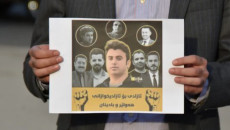



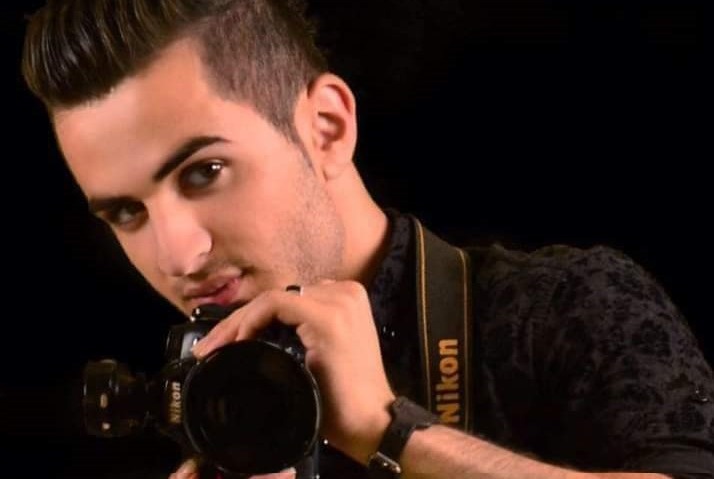

Khawla Taha, the mother of imprisoned photojournalist Qareman Shukri, continues to live with deep worry over her son’s fate. Despite a decision by the President of the Kurdistan Region to reduce his sentence, Shukri remains behind bars.
“Every time I visit my son in prison, I suffer emotionally and lose my strength. It takes several days before I can recover,” Khawla said. She has been raising her children alone since the assassination of her husband ten years ago in an unresolved incident. Now her main concern is her eldest son, Qareman.
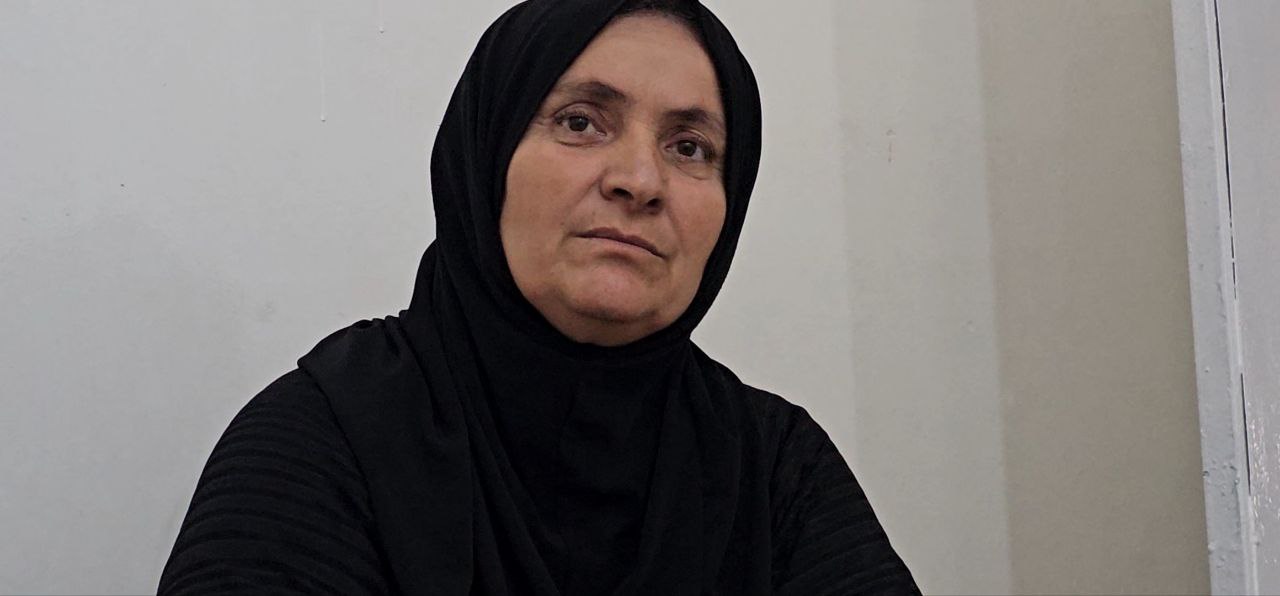
Khawla Taha, mother of Qareman Shukri. KirkukNow
Qareman Shukri, 32, who previously worked with Rojnews, Star TV, and KNN, has spent nearly five years in prison. A court in Duhok sentenced him to seven years in prison in a trial where he was reportedly not allowed to appoint a lawyer.
The Arrest of Qareman Shukri
Qareman, the eldest in a family of twelve children—five brothers and six sisters—was arrested on December 27, 2021, by security forces in the Sere area of Shiladze, in Amedi district of Duhok province. He went missing for 97 days.
In June of that year, his family was able to visit him in prison for the first time. During that visit, Qareman told his mother that he had been sentenced to seven years in prison and had been prevented from hiring legal representation.
Most of Shukri’s work involved photography for the media outlets he collaborated with. He was convicted under Law No. 21 of 2003, which concerns espionage and actions that threaten national security. Critics argue that applying this law contradicts the Kurdistan Region of Iraq KRI’s Prss Law, which states that journalists should be prosecuted according to media legislation.
Currently held at the Duhok Correctional Facility, Shukri lost his father who was assassinated on December 31, 2016, under unclear circumstances.
“We are living in very difficult conditions. Every time I visit Qareman, I become deeply upset. My son has done nothing wrong. We do not know where to seek help. May God help us,” Khawla told KirkukNow.
She added that the family longs for the day he returns home. “We wish to start a new life again, just as when Qareman used to knock on the door and come inside. Now we live only with his photos, memories, and kind words.”
Local and international media outlets and organizations, advocates and MPs expressed their grave concern that that press freedom is increasingly under threat in the Kurdistan Region of Iraq.
The Iraqi Kurdistan Journalists Syndicate KJS documented only 46 violations against journalists in the Kurdistan Region of Iraq KRI in 2025, a figure that sharply contrasts with a report released two days earlier by the Metro Center for Journalists Rights and Advocacy, which recorded 315 violations.
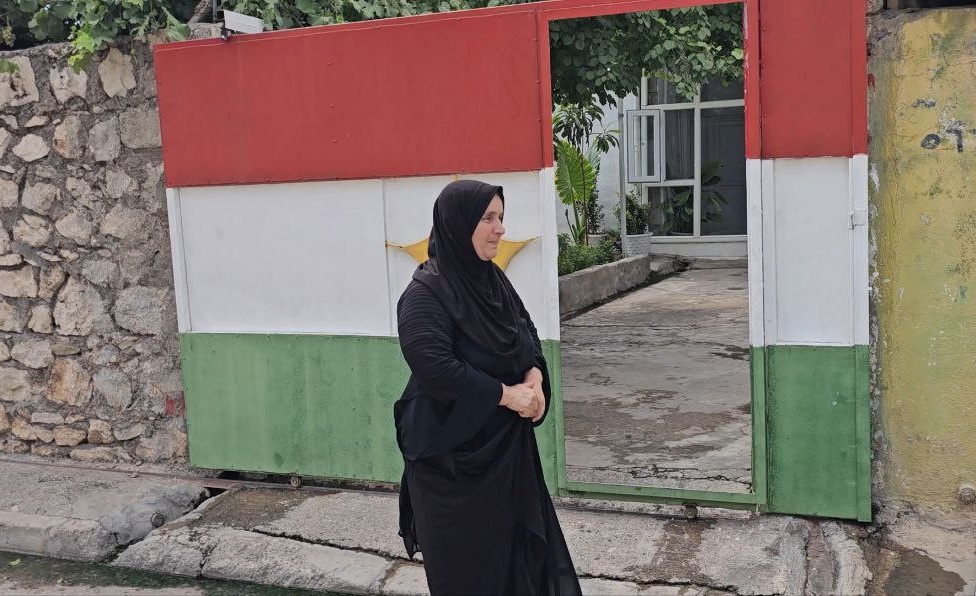
Sentence Reduction Yet to Be Implemented
On July 9, 2024, Kurdistan Region of Iraq President KRIP Nechirvan Barzani ordered a 60 percent reduction in Shukri’s sentence, according to his lawyer Ramazan Artisi, under the authority granted by the Presidency Law. However, the decision has not yet been implemented.
“We are constantly in contact with international organizations and legal representatives to ensure the president’s decision is enforced, but there appears to be no progress,” said Zerevan Shukri, Qareman’s brother. “We have followed the case closely but still do not understand why the decision has not been carried out.”
The spokesperson for the KRIP, Dilshad Shahab, did not respond to requests for comment from KirkukNow.
International Criticism
On June 28, 2021, the Committee to Protect Journalists (CPJ) called for Shukri’s immediate release and demanded that the charges against him be dropped. The organization also criticized the Kurdistan Regional Government for its treatment of journalists.
“Kurdish authorities in northern Iraq are making an appalling habit of sentencing journalists to prison without any regard for due process and for the rights and freedoms they claim to defend,” said Ignacio Miguel Delgado, CPJ’s Middle East and North Africa MENA representative.
Observers say Shukri’s case reflects a broader pattern in which journalists are prosecuted under laws related to national security rather than media legislation. In some cases, they are also denied the right to legal counsel, despite laws guaranteeing that right.
For instance, Article 23 of the Criminal Procedure Code states that any accused person must be brought before a court within 24 hours and has the right to appoint a lawyer and receive legal advice before and during investigations. According to his family and lawyers, these rights were not respected in Shukri’s case.
The Duhok branch of the Kurdistan Union of Journalists (KUJ) previously stated that it did not intervene in Shukri’s case because authorities claimed his arrest was unrelated to journalism, according to branch head Vian Abbas.
Even five years after the sentence, the court has not clearly explained how Shukri allegedly attempted to “undermine national security.”
Family Still Seeking Justice
Khawla said she visited her son earlier this month and discussed possible steps to secure his release. Visits are permitted occasionally under the prison’s schedule.
“My son is psychologically exhausted,” she said.
Another brother, Shorshvan Shukri, recently went to court to request the addition of a new lawyer from Erbil to review the case more thoroughly. The request was rejected.
“There has been complete silence regarding Qareman Shukri’s case,” said his lawyer Ramazan Artisi. “All legal procedures have been followed, yet the president’s decision has still not been implemented.”
Law No. 21 of 2003
Law No. 21, which has been used in several cases against journalists, was passed by the Kurdistan Parliament on September 27, 2003, aimed to amend certain provisions of the Iraqi Penal Code.
The law contains six articles. The first article replaces Article 156 of the Iraqi Penal Code, addressing acts that deliberately threaten the security, stability, or sovereignty of the Kurdistan Region’s institutions.
It was officially published in the 45th issue of the Kurdistan Waqaea (Reality) newspaper on October 28, 2003, and remains in force.
Although similar to Article 156 of the Iraqi Penal Code No. 111 of 1969, the Kurdistan version includes slight differences in wording and the severity of penalties. Under the Iraqi law, anyone found deliberately endangering the country’s independence, unity, or territorial security may face the death penalty.
Brought before Erbil Criminal Court on February 15 and convicted in the following day, the freelance journalists Sherwan Sherwani, Guhdar Mohammed Zebari, and civil society activists Ayaz Karam, Hariwan Essa and Shivan Sa'id, and tens in prison are victims of a wave of arrests carried out by the (KRG) since October in response to a series of major protests against delay in salaries of state employees, KRG handling of the economic crisis resulting from disputes with Baghdad over oil production, export and corruption, and reached its peak under the Covid-19 pandemic.