



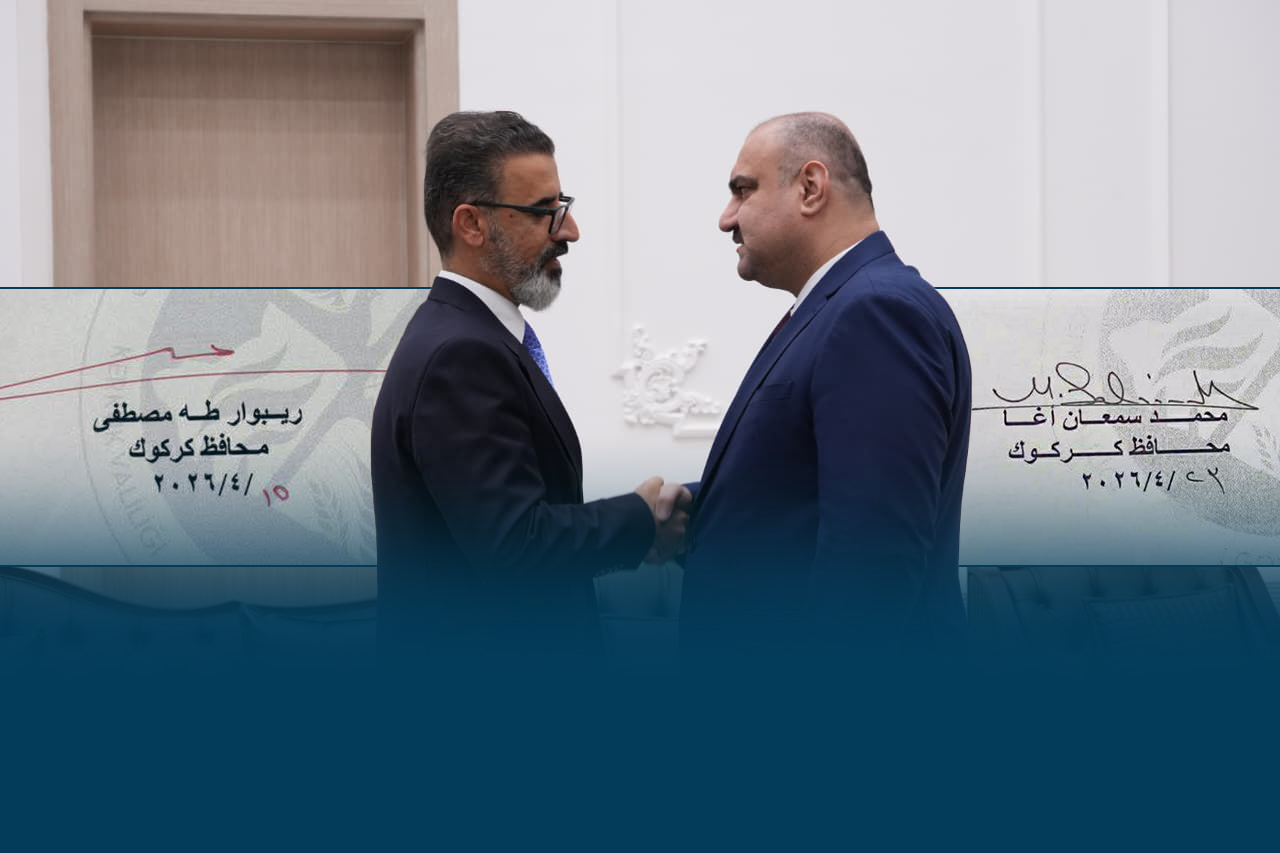

The new governor of Kirkuk has issued an administrative order revoking powers from his deputies—powers that had been granted by his predecessor only one week before leaving office.
Official documents obtained by KirkukNow point to differing administrative approaches between the former and current local administration of the oil-rich, multi-ethnic province of Kirkuk. While the previous administration emphasized distributing responsibilities and expanding the authority of deputies and assistants, the new administration quickly moved to reclaim key departments and place them under the governor’s direct supervision.
The northern, oil-rich, ethnically mixed province of Kirkuk is home to approximately 1.77 million Kurds, Turkmen, and Arabs. Located 238 kilometers north of Baghdad, it has long been at the center of disputes between the federal government in Baghdad and the Erbil-based Kurdistan Regional Government (KRG).
According to the documents, former governor and current deputy governor Rebwar Taha, member of the Patriotic Union of Kurdistan PUK, issued Administrative Order No. 7666 on April 15, 2026, assigning deputies authority over several sensitive files. The Property, Citizens’ Affairs, and Follow-up departments were attached to the office of the First Deputy Governor, while security clearances were placed under the Technical Deputy Governor.
However, the arrangement was short-lived. New Governor Mohammed Samaan Agha, head of the Iraqi Turkmen Front ITF, issued Order No. 8027 on April 23, 2026, requiring all of those departments to be separated from the deputies’ offices and reattached to the governor’s office.
The changes restored the governor’s direct oversight of the Property Department, which handles some of Kirkuk’s most complicated matters, the Security Clearances Department, which is tied to stability and vetting procedures, and the Citizens’ Affairs Department, aimed at ensuring direct communication between residents and the province’s top executive authority.
These developments come amid Kirkuk’s complex political environment, where the appointments of Agha as governor and Taha as deputy governor were part of a power-sharing arrangement that ended nearly 20 months of political deadlock.
Under the agreement reached at Baghdad’s Al-Rashid Hotel in August 2024, the Kirkuk governorship would remain with the Kurds until December 31, 2025, then be transferred to the Turkmen as of December 2026, and later to the Arabs.
The Kirkuk local government was established with the participation of five PUK members, two members of the Leadership List, the sole Arab representative, and the only Christian member—bringing the total to nine out of 16 council members.
However, seven other members did not take part in the agreement and remained in opposition. This group included three members from the Arab Coalition in Kirkuk, two from the Kurdistan Democratic Party (KDP), and two from the (ITF).
During the Ba'athist regime, most key positions of power in Kirkuk were held by the Arab community without any elections. After 2003, the Kurds assumed executive power until 2017. The Arab community regained the governorship when al-Jiburi, the deputy governor, was appointed governor of Kirkuk. The Kurds then reclaimed the position in 2024 with the appointment of Taha as governor. Currently, the position is held by a Turkmen.
The first governor of Kirkuk after the 2005 provincial council elections was Abdul Rahman Mustafa, a Kurd. In 2011, Najmadin Karim, from the (PUK), was elected governor by the same council. Six years later, he was removed from office by a decision of the Iraqi parliament.
After 2003, based on a proposal by the late Jalal Talabani, former President of Iraq and former Secretary-General of the PUK, it was decided to distribute administrative positions in Kirkuk Province with 32 percent allocated to each of the Kurds, Arabs, and Turkmen, in addition to 4 percent for the Christian community. This proposal was approved by the Kirkuk Provincial Council on July 28, 2009, although this agreement did not extend to other positions.