



Kurdish and Turkmen members of the Iraqi Parliament from Kirkuk have expressed opposition to plans to allocate land to government employees, raising concerns that plots whose ownership remains disputed—or which they say belong to Kurdish and Turkmen citizens—could be included in the process.
The Iraqi government has launched a nationwide project to distribute one million residential plots to eligible citizens. In Kirkuk, however, the initiative has triggered opposition, with lawmakers warning of possible protests.
Kurdish and Turkmen MPs are calling for privately owned land, as well as land whose ownership remains disputed under Article 140 of the Iraqi Constitution, to be excluded from the distribution.
Arshad al-Salihi, head of the Turkmen Front bloc in the Iraqi Parliament, criticized the plans during a press conference on Monday, September 21. “Any minister, regardless of ethnicity, arrives in Baghdad believing the ministry belongs to his father or his tribe. You have no right to distribute Kirkuk’s lands,” he said.
He added that ministers have issued directives to the Ministry of Agriculture and the Investment Commission to authorize projects on disputed lands, saying, “These lands do not belong to your fathers.”
Regarding the proposed allocation to government employees, al-Salihi said the Ministry of Oil had identified areas that he claimed were owned by Turkmen or Kurdish citizens and intended to distribute them.
“We will not accept this from any ministry—whether it is the Ministry of Oil, Agriculture, Finance, or Defense,” he said.
The northern, oil-rich, multi-ethnic Kirkuk Province, home to more than 2.34 million Arabs, Kurds and Turkmen,, remains one of Iraq’s disputed territories between the federal government and the Kurdistan Regional Government. Its future status is tied to Article 140 of the Iraqi Constitution.
Press conference by Turkmen lawmaker Arshad Salihi supported by KDP and PUK lawmakers from Kirlkuk
Kurdish MPs representing the Patriotic Union of Kurdistan (PUK) and the Kurdistan Democratic Party (KDP) also endorsed al-Salihi’s position during the press conference.
“There is no land left in Kirkuk... You have destroyed Kirkuk for the sake of your personal interests,” al-Salihi said.
You have destroyed Kirkuk for the sake of your personal interests
The statements prompted mixed reactions. Some accused al-Salihi of opposing the distribution of land to government employees, while others viewed the effort to prevent the distribution of plots whose ownership remains unresolved under Article 140 as an important measure.
In response to the joint press conference, Raad al-Saleh, an Arab representative on the Kirkuk Provincial Council, called on those opposing the distribution plans to provide evidence of land ownership. In a Facebook post, he wrote, “We want to prove to you that this is state-owned land.”
Al-Saleh also said, without naming specific individuals, “The people of Kirkuk should know who is behind the delay and the denial of their entitlements regarding the Prime Minister’s initiative—the very same people responsible for delaying the file concerning the 7,304 job contracts.”
The people of Kirkuk should know who is behind the delay and the denial of their entitlements
Ahmed Ramzi, a Kirkuk Provincial Council member representing the Iraqu Turkmen Front ITF, said there was evidence that some of the disputed lands belonged to Turkmen, Kurds, and Arabs.
“If your evidence is that the land is state-owned, then the proof you hold consists of decisions made by the dissolved Revolutionary Command Council of the defunct Ba’ath Party,” Ramzi said. “Lawsuits regarding these lands are still active within property dispute proceedings.”
Ramzi stressed that he was not opposed to distributing land to government employees, but said the process should use plots free of ownership disputes to prevent future conflicts.
Ahmed Kirkuki, a provincial council member representing the PUK bloc, wrote on Facebook that the issue was one of rights and law.
“We support the distribution of land to eligible residents from all segments of Kirkuk’s population without discrimination,” he wrote. “At the same time, however, no land subject to ownership disputes may be distributed until its legal status is resolved. This is necessary to protect the rights of the original owners and to shield the beneficiaries themselves from future conflicts.”
no land subject to ownership disputes may be distributed until its legal status is resolved
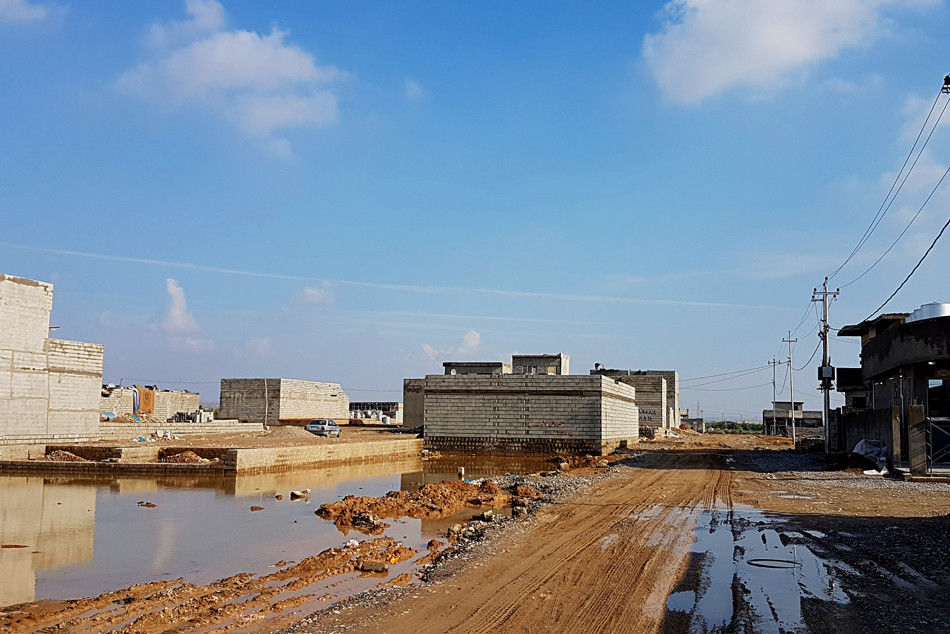
Last month, residents of Topzawa village in Kirkuk, which has a mixed Kurdish and Turkmen population, demonstrated against a Kirkuk Provincial Council plan to distribute 850 donums of village land to government employees. The protesters called for the implementation of legislation concerning the restoration of land to its original owners.
The legislation concerns the annulment of decisions issued by the Revolutionary Command Council during the former Ba’athist regime. It provides for the return of land and real estate in Kirkuk, Diyala, Salah al-Din, and other governorates to their original owners.
The law was passed on January 21, 2025, and covers land whose ownership had been transferred through Revolutionary Command Council decrees to the Ministries of Defense, Oil, and Finance, as well as to local government administrations.
The return of seized lands to its owners was one of the most complicated issues in Kirkuk province and other disputed territories, pending for 20 years. This has led to several clashes between Kurdish, Arab and Turkmen farmers.
Al-Salihi expressed support for implementing the law and threatened to organize demonstrations against Iraqi government ministries if they continued with their current approach to land distribution in Kirkuk. He also accused the ministries of acting in a sectarian and discriminatory manner.
“Kirkuk is a sensitive province, and there are disputes and conflicts regarding its land,” al-Salihi said.