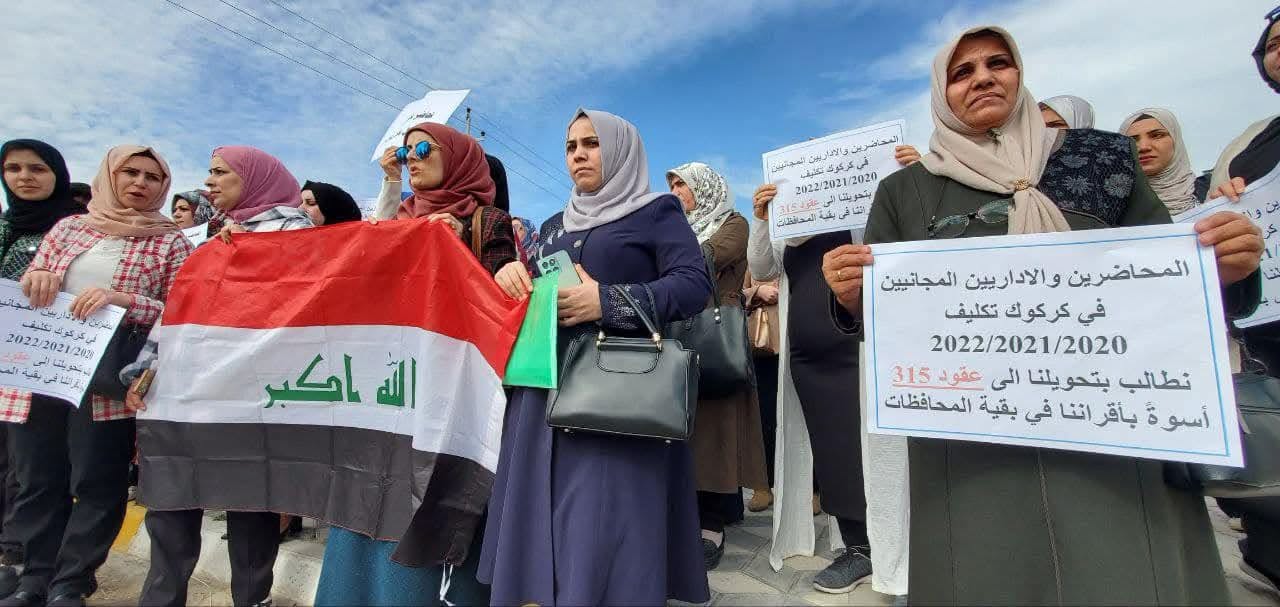

Kirkuk’s newly appointed governor, Qahtan al-Wandawi, has repeated the promises made by his predecessors regarding the creation of 7,000 job opportunities, which have remained unfulfilled in recent years due to political and communal disputes in Kirkuk.
Qahtan, who assumed office on November 14, said during a television interview that he would continue coordinating with the federal government to announce the names of those selected for the 7,000 positions. These jobs were supposed to be established under the 2023 and 2024 budget allocations.
“Several parties are responsible for delaying the announcement of the contracts. Administrative and financial obstacles have prevented the positions from being announced,” he stated.
Previously, during the campaign for the Iraqi parliamentary elections, Rebwar Taha, the former governor of Kirkuk and head of the Patrioti Union of Kurdistan PUK electoral list, announced the launch of an electronic application link and pledged that the job positions would be announced as soon as possible.
Former Kirkuk governor Mohammed Samaan also made a similar commitment, promising that the positions would be announced in the near future.
Despite these repeated assurances, all three governors have served for varying periods, including up to two years and three months, without fulfilling the promise.
Unemployment Rate in Iraq increased to 15.50 percent in 2025 from 15.30 percent in 2024. Unemployment Rate in Iraq averaged 10.28 percent from 1991 until 2025, reaching an all-time high of 16.20 percent in 2021 and a record low of 8.00 percent in 1999, says International Labor Organization (ILO).
“The 7,000 positions were included in the 2023–2025 budget allocations and represent a legal entitlement,” Dylan Ghafoor, a PUK member of Iraqi parliament representing Kirkuk, told the party’s Kirkuk channel.
“Their names and positions should have been announced before 2026. However, political disputes and the absence of consensus delayed the process until 2026.”
She added that the issue had been followed up with officials, including the finance minister. During their most recent discussion, the minister reportedly said that he could not allocate funding for the positions in 2026 because there was no budget law in place, leaving little hope for their announcement this year.
“However, one possible solution is to include a legal provision in the 2027 budget law to restore this entitlement to the people of Kirkuk and formally guarantee it through legislation. This would require considerable support from MPs,” she said, adding that discussions are still ongoing and the budget bill remains with the Council of Ministers, awaiting approval.
Of Iraq’s 40 million people, approximately 9.2 million are employed. The country’s economy remains heavily dependent on the state, with the oil sector generating around 85% of government revenue. Meanwhile, public-sector salary expenditure has risen sharply, with the government now spending four times as much on salaries as it did 15 years ago. In 2020, approximately three-quarters of total state expenditure was allocated to paying public-sector employees.