


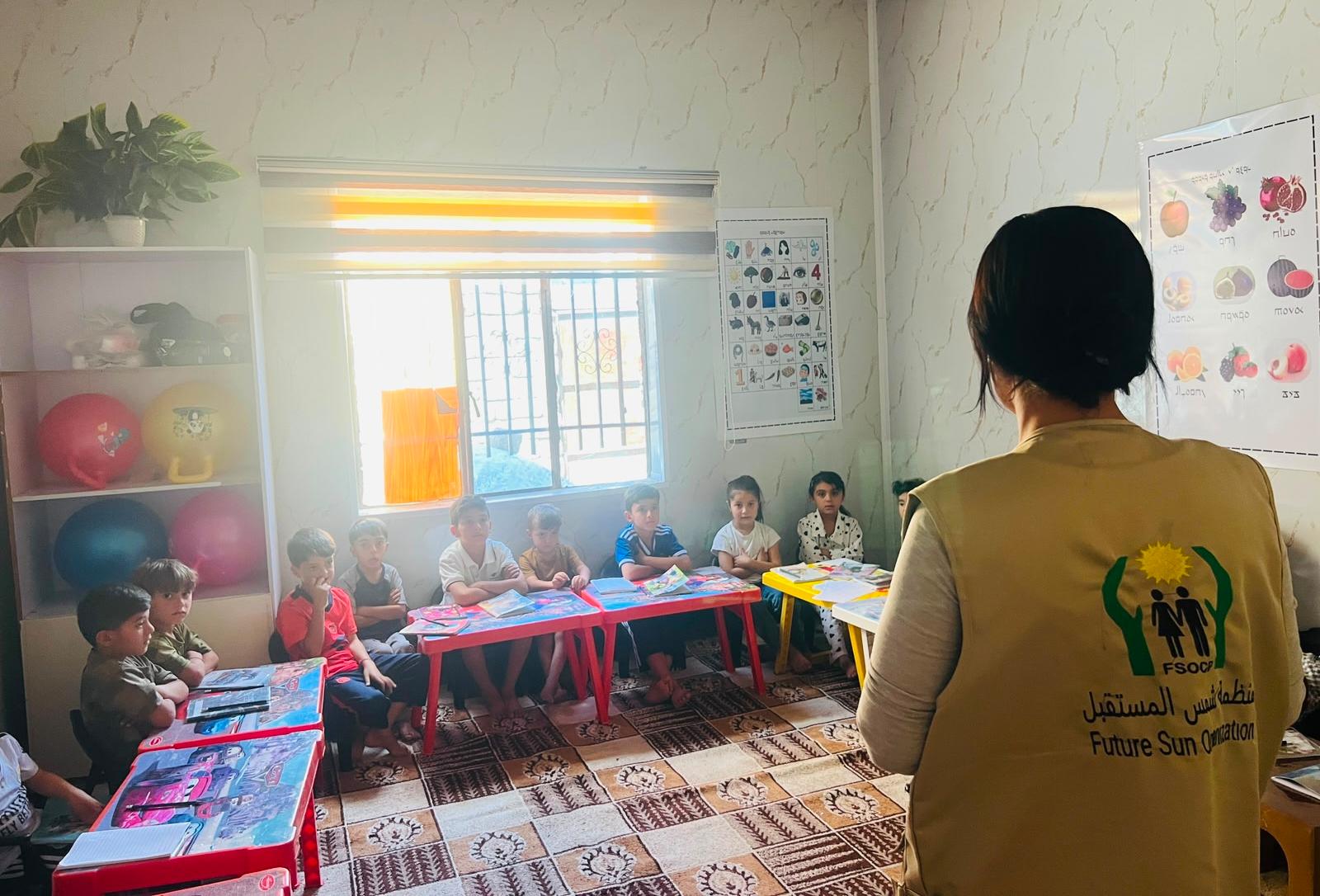

A new school opened doors in Shingal (Sinjar) district with the goal of preserving the mother tongue and traditional dialect spoken by the Ezidi community. Linguists warn that nearly 6,000 Ezidi words and expressions are at risk of disappearing as younger generations increasingly adopt other languages in their daily lives.
The school, which began operating in mid-June, functions independently of both the Iraqi Federal Ministry of Education and the Kurdistan Regional Government KRG's Ministry of Education. Its primary mission is to teach children the Ezidi mother tongue and encourage them to use the dialect in everyday conversation.
The initiative is overseen by a local non-governmental organization NGO called Shamsi Ainda (Future Sun), with support from language specialists and experts familiar with the Ezidi dialect.
"Children first learn the alphabet, then they are introduced to the traditional Ezidi dialect spoken in daily life," said Ajaj Hassan, head of Shamsi Ainda, in an interview with KirkukNow. "We encourage them to speak the dialect because preserving it is essential."
According to researchers specializing in the Ezidi language and dialect, approximately 6,000 words and expressions are gradually falling out of use due to language mixing and the growing influence of Arabic and other regional dialects.
Ezidism is an ancient monotheistic ethnic religion originating in the Middle East. Its followers believe in one God, who created the universe and entrusted its care to seven sacred beings, known as Angels. The foremost of these is Melek Taus, who is regarded as the chief Angel and the divine representative responsible for overseeing the world.
Most Ezidis speak Kurmanji, one of the two principal dialects of Kurdish. While many identify linguistically with the Kurdish language, some Ezidis consider both their religion and their ethnicity to be distinct from Kurdish identity.
"We want to place greater emphasis on preserving our mother tongue, especially among younger generations," Hassan said. "In our everyday conversations, many traditional Ezidi words have already been replaced by Arabic expressions."
The school provides free education through three levels: kindergarten, primary, and advanced classes. Enrollment is open to children generally between the ages of four and seven, although there is some flexibility. Each stage lasts approximately one year and four months.
Organizers hope to expand the project by opening similar schools in other Ezidi communities across Iraq and eventually in Ezidi diaspora communities abroad.
In Ezidi-dominated areas, the KRG education system includes a subject on Ezidism, taught in both Kurdish and Arabic. However, the curriculum primarily focuses on the Ezidi religion, its holidays, and religious ceremonies rather than on preserving the community's spoken dialect.
Hassan believes the curriculum should be revised to place greater emphasis on language preservation.
"Instead of focusing mainly on introducing the religion, the program should give more attention to teaching the Ezidi dialect so that the language remains alive for future generations," he said.